
News

Moving beyond single-wavelength gas sensors
2026-11-24
As gas sensing and hydrocarbon monitoring applications become more demanding, instrument developers face increasing pressure to deliver higher sensitivity, better selectivity, and long-term stability. While traditional single-wavelength sensors remain suitable for basic detection, full-spectrum UV and NIR spectroscopy opens new possibilities for advanced monitoring of greenhouse gases, toxic gases, hydrocarbons, and industrial processes. In this newsletter, we explore why full-spectrum solutions are becoming a preferred approach for next-generation gas and oil sensing instruments. As a dedicated OEM supplier, Ibsen Photonics provides high-performance spectrometer modules designed specifically for seamless instrument integration. We specialize in the compact optomechanical hardware that serves as

The field demands reliability: Why environmental qualification of spectrometers matters
2026-10-15
Every instrument maker dreads the moment a customer calls from a freezing job site or a factory floor to report that their instrument isn't reading right, and nobody did anything wrong. Spectrometers don't live in pristine labs anymore. They are deployed in industrial, portable, and field applications where environmental conditions can be highly unpredictable. Repeated exposure to temperature swings, high humidity, vibration, or shock can cause a spectrometer to drift out of wavelength calibration, lose spectral resolution, or suffer reduced sensitivity. In the worst cases, these stresses can lead to irreversible failure. Environmental qualification verifies that a spectrometer can withstand
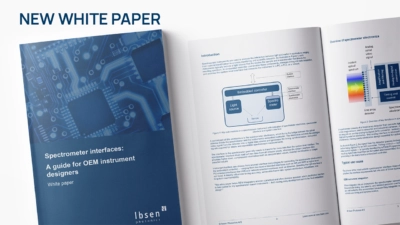
Spectrometer Interfaces: A Guide for OEM Instrument Designers
2026-09-16
Choosing the right interface technology for connecting a spectrometer to an embedded controller is a critical decision for instrument builders. Options like SPI, MIPI, USB, and Ethernet each come with trade-offs that directly impact timing accuracy, frame rate, system architecture, robustness, and long-term maintainability. Our new white paper, “Spectrometer Interfaces: A Guide for OEM Instrument Designers,” provides practical guidelines to help you navigate this decision for your specific application. In this paper, you’ll: Understand the fundamentals of how USB, Ethernet, SPI, MIPI, and Camera Link operate. Compare key characteristics, including maximum frame rate, latency, and implementation complexity. Access a clear
Ibsen Sustainability Report 2025 is now available
2026-09-03
Sustainability is becoming an increasingly important part of how companies evaluate their operations, supply chains and long-term partnerships. At Ibsen Photonics, we are committed to combining technological innovation with responsible business practices and continuous improvement. We are pleased to announce that the Ibsen Sustainability Report 2025 is now available. The report provides insight into our sustainability approach, commitments and initiatives, as well as how we work to create long-term value for our customers, employees, suppliers and other partners. As a global leader in OEM spectrometers and transmission gratings, we are proud to drive innovation while actively working to reduce our

The spectral engine behind next generation light and display quality
2026-08-18
In modern light and display systems, visible light spectral data has become essential for achieving consistent color, brightness, and performance across devices and production environments. As form factors shrink and integration demands grow, compact and fast OEM spectrometers offer a reliable way to monitor and control optical output directly inside the manufacturing line. Our Visible light (VIS) spectrometers are designed specifically for demanding needs in light and display quality control. Due to our fused silica transmission grating technology the spectrometers deliver high throughput, low stray light, and excellent wavelength stability across the full visible range defined in common lighting and