
Transmission gratings for optical devices in telecom networks
Durable, High‑Efficiency Fused Silica Transmission Gratings
Optical devices in telecom networks rely on precise wavelength control. Transmission gratings play two essential roles in this ecosystem. They can act as the manufacturing tool used to write Bragg gratings in fibers or wafers, and they can function as wavelength‑selective components within telecom systems themselves.
Our range of fused‑silica transmission grating products includes both Phase masks and polarization independent gratings (PING) for wavelength selective telecom devices. Out gratings offer exceptional stability, high diffraction efficiency, and polarization independent performance. Their durability and long‑term reliability make them ideal for OEMs developing next‑generation optical devices in telecom networks. With decades of experience in semiconductor manufacturing technologies, we deliver gratings that ensure consistent performance, low loss, and dependable scalability for demanding telecom environments.
Why choose Ibsen’s transmission gratings for devices in telecom networks?
Ibsen Photonics is your trusted and stable supplier of the highest quality phase masks for Bragg grating manufacturing, backed by over 30 years of product and market expertise. At the heart of our phase mask fabrication is Ibsen’s holographic/interferometric patterning technology, globally recognized for its unparalleled grating period and chirp precision.
Ibsen’s advanced, PING (Polarization Independent Gratings) gratings have served as optical components in telecom networks for decades by providing the world’s highest diffraction efficiency, unmatched thermal and environmental stability, and ultra-low polarization dependent loss (PDL). Our manufacturing processes are optimized for high volume supply of PING gratings with high and consistent performance.
Why leading OEMs partner with Ibsen:
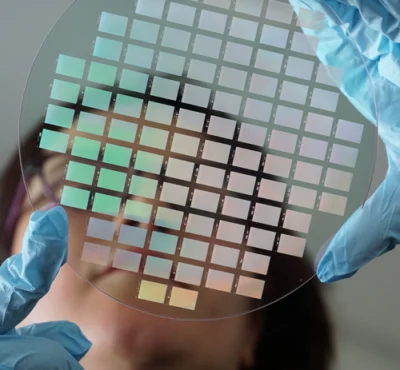
Where are transmission gratings used for optical devices in telecom networks?
FBG manufacturing
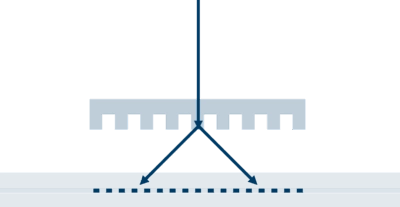
Phase‑masks are manufacturing tools used to produce high quality Fiber Bragg Gratings, enabling precise and repeatable inscription of periodic index changes directly into the fiber core. In a typical setup, a UV laser – most commonly operating at 193 nm (ArF excimer), 248 nm (KrF excimer), or frequency‑doubled/frequency‑tripled solid‑state sources around 244–266 nm – illuminates the fused silica phase mask to generate a stable interference pattern with the exact pitch required for the target Bragg wavelength. Because the phase mask defines the grating period, its dimensional accuracy and long‑term durability is critical for maintaining wavelength consistency across high‑volume production. The intense UV fluence places stringent demands on material purity, thermal stability, and surface quality, ensuring that the mask can deliver uniform fringe contrast, minimal wavefront distortion, and reliable performance over thousands of writing cycles. Together, these characteristics make phase masks the preferred tool for producing telecom‑grade FBGs with tight spectral tolerances and excellent batch‑to‑batch repeatability.
Wavelength selective switches
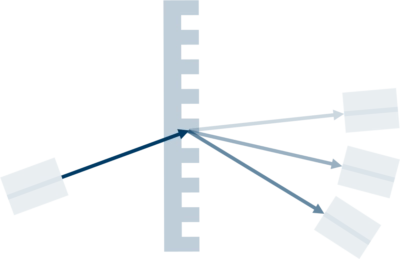
Wavelength‑selective switches (WSSs) enable dynamic routing, add‑drop functionality, and flexible bandwidth allocation across dense WDM systems. Inside a WSS, diffraction gratings spatially separate tightly spaced channels so they can be individually attenuated, redirected, or switched by MEMS mirrors, LCOS arrays, or other beam‑steering elements. The grating must deliver high diffraction efficiency, low polarization‑dependent loss, and exceptionally low wavefront distortion to preserve channel integrity across the C and L bands. Because WSS modules operate continuously in demanding thermal and mechanical environments, the optical components require long‑term stability, precise angular dispersion, and excellent environmental durability to maintain consistent performance over years of network operation.
Tunable filters
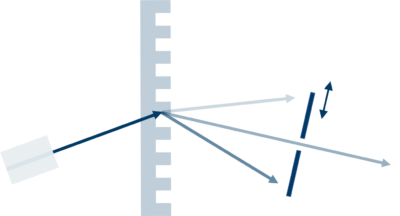
Tunable optical filters enable dynamic wavelength selection across and beyond the C and L bands. In many architectures, a diffraction grating is used to disperse the incoming broadband signal so that individual wavelengths can be isolated by a movable slit, fiber, or MEMS‑based aperture positioned in the focal plane. Because these filters must deliver low insertion loss, tight wavelength accuracy, and stable performance over wide temperature ranges, the dispersive element must provide high efficiency, minimal wavefront distortion, and excellent long‑term durability.
Optical channel monitors
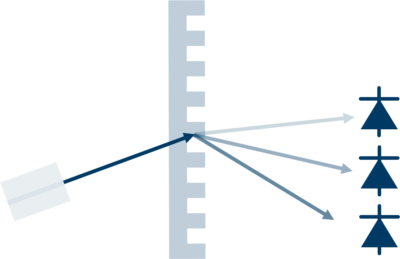
Optical channel monitors are diagnostic components in dense WDM networks, providing continuous insight into channel power and wavelength accuracy. Inside an OCM, a diffraction grating disperses the incoming multiplexed signal so that each channel can be measured individually by a photodiode or scanning detector. To ensure reliable performance, the dispersive element must deliver high efficiency, low wavefront distortion, and stable angular dispersion so that channel positions remain consistent over temperature and time. Because OCMs operate as always‑on monitoring elements in live networks, long‑term durability, precise spectral mapping, and excellent environmental stability are critical to maintaining accurate power balancing and early fault detection.
Our transmission gratings for optical devices in telecom networks
Ibsen is your trusted and stable supplier of the highest quality phase masks and telecom transmission gratings, backed by over 30 years of product and market expertise.
At the heart of our fabrication is Ibsen’s holographic patterning technology, globally recognized for its unparalleled grating period and chirp precision. For more advanced patterning requirements, we also employ photo-mask patterning technology.
Combined with high-fidelity RIE etching processes, the purest silica material available, and precise metrology, Ibsen offer the world’s best transmission gratings for wavelength selective optical components in telecom networks.
For more information about our Phase masks and telecom transmission gratings please select below:
Phase mask: +1/-1 | 0/-1
PING gratings: C-band | L-band | O-band
More resources
Want to know more?
For further information see below.