
Frequently asked questions
General questions about Raman Spectrometers
The term Raman spectrometer can have different meanings depending on the context. At Ibsen we identify a Raman spectrometer as a device that detects the spectrum from Raman scattered light. As such, it is a sub-part of a complete Raman spectroscopy instrument. However, you may also find the term Raman spectrometer used for the complete instrument.
A Raman spectroscopy instrument is a device that uses the Stokes or anti-stokes wavenumber shift caused by Raman scattering to identify and/or quantify materials.
A Raman spectroscopy instrument works by illuminating a sample with monochromatic light (typically from a laser) and detecting the spectrum of the Raman scattered light.
The key components of a Raman spectroscopy instrument are: a laser, a probe, a spectrometer, and a software model.
A Raman spectrometer typically consists of an entrance slit followed by collimating optics, a diffraction grating, focusing optics and a photo-detector array.
A Raman spectrometer uses a diffraction grating to separate the different wavelength components of the Raman spectrum angularly. The different wavelengths are focused on a linear photo-detector array which converts the light intensity at each wavelength to a voltage/current. A Raman spectrometer will include a narrow aperture (slit) at the entrance which determine the resolution of the spectrometer.
General questions about OCT Spectrometers
An OCT (Optical Coherence Tomography) spectrometer is an optical device used to measure the intensity of light across different wavelengths. It is used in OCT systems to generate detailed cross-sectional images of biological tissues.
OCT spectrometers are widely used in medical imaging, particularly in ophthalmology for retinal scans, as well as in cardiology, dermatology, and oncology. They are also used in industrial inspection, material science, and research.
Key factors include spectral range, resolution, sensitivity, roll-off, form factor, data interface options, and the specific requirements of your application such as the type of tissue or material you are analyzing.
An OCT spectrometer measures the interference pattern of light reflected from different depths within a sample. This data is processed to create high-resolution cross-sectional images, revealing detailed internal structures.
Roll-off refers to the decrease in sensitivity and signal strength as the depth of the sample increases. Minimizing roll-off is important for maintaining image quality at greater depths.
Yes, OCT spectrometers can be fully customized or adapted to meet the specific needs of different applications. This includes adjustments in spectral range, resolution, and form factor.
Common data interfaces include MIPI, USB, and CameraLink. The choice of interface depends on the desired data transfer speed and the compatibility with existing systems.
Yes, Ibsen Photonics offers standard OEM spectrometers with various configurations and data interfaces to suit different applications. These spectrometers offer a balance of performance and cost-effectiveness.
General questions about LIBS Spectrometers
A LIBS (Laser Induced Breakdown Spectroscopy) spectrometer is an analytical device that measures the light emitted from a plasma created by a laser pulse. This light emission is used to determine the atomic composition of the sample.
LIBS spectrometers are used in various fields such as materials science, metallurgy, environmental monitoring, pharmaceuticals, forensics, and geology. They are also widely used for quality control in manufacturing and industrial processes. Our LIBS spectrometers are extensively used in metal and mineral analysis for material characterization and quality control of raw materials.
A LIBS spectrometer works by firing a high-energy laser pulse at the sample, creating a plasma. The emitted light from this plasma is then analyzed by the spectrometer to identify the elements present in the sample.
Advantages include rapid and real-time analysis, minimal sample preparation, the ability to analyze solid, liquid, and gaseous samples, and the capability to detect a wide range of elements simultaneously.
The required spectral range for a LIBS spectrometer largely depends on the atomic elements that need to be identified. Atomic transitions range from the UV through the NIR.
Key factors include sensitivity, resolution, spectral range, and synchronization between laser and spectrometer as well as environmental stability.
Yes, LIBS spectrometers can be customized to meet the specific needs of different applications, including adjustments in spectral range, resolution, and form factor.
Common data interfaces include USB and SPI. The choice of interface depends on the desired data transfer speed and compatibility with existing systems.
General questions about UV Spectrometers
A UV spectrometer is an instrument used to measure the intensity of light in the ultraviolet range (175-400 nm) of the electromagnetic spectrum. It analyzes how light interacts with a sample, providing valuable data for various applications and is therefore often also called a UV light spectrometer.
Please note, that in some contexts a UV spectrophotometer denotes a spectrometer that covers both the UV and visible wavelength ranges.
UV spectrometers utilize a diffraction grating to disperse the spectrum across a photo-detector array
UV spectrometers are versatile tools used in many different applications like fluorescence and absorbance spectroscopy as well as Laser Induced Breakdown Spectroscopy.
When selecting a UV spectrometer, consider your requirements for wavelength range, resolution, sensitivity, and signal-to-noise ratio as key factors. Also, footprint, environmental robustness and cost should be considered.
Yes, our UV spectrometers are designed as OEM modules for seamless integration into your systems. Their compact design and advanced electronics ensure easy incorporation into various setups. Thanks to their modular spectrometer design, our solutions can be tailored to meet application-specific requirements across multiple industries.
OEM UV spectrometers offer high sensitivity and resolution, compact design, and robust construction. They provide accurate measurements and are suitable for both laboratory and field applications, enhancing your system’s capabilities. For OEM customers, we offer custom spectrometer solutions that integrate seamlessly into larger analytical systems and instruments.
General questions about UV-VIS Spectrometers
A UV-VIS spectrometer is an instrument used to measure the intensity of light from the ultraviolet to the visible range and sometimes also into the near infrared range of the electromagnetic spectrum. It analyzes how light interacts with a sample, providing valuable data for various applications.
Please note, that in some contexts a UV-VIS spectrometer is sometimes called a UV spectrophotometer or UV detector.
UV-VIS spectrometers utilize a diffraction grating to disperse the spectrum across an array of photo-detectors
UV-VIS spectrometers are versatile tools used in many different applications. Some of the more common applications are as UV-detector in HPLC systems and thin film measurements of coatings.
When selecting a UV-VIS spectrometer, consider your requirements for wavelength range, resolution, sensitivity, and signal-to-noise ratio as key factors. Also, footprint, environmental robustness and cost should be considered.
Yes, our UV-VIS spectrometers are designed as compact OEM modules ideal for seamless integration into your systems. Their compact design and advanced electronics ensure easy incorporation into various setups.
OEM UV-VIS spectrometers offer high sensitivity and resolution, compact design, and robust construction. They provide accurate measurements and are suitable for both laboratory and field applications, enhancing your system’s capabilities.
General questions about VIS Spectrometers
A VIS spectrometer is an instrument used to measure the intensity of light in the visible range (400-700 nm) of the electromagnetic spectrum. It can be used to analyze how light interacts with a sample, providing valuable data for various applications.
VIS spectrometers can also be called VIS spectrophotometers or visible spectrophotometers.
VIS spectrometers utilize a diffraction grating to disperse the spectrum across an array of photo-detectors.
VIS spectrometers are versatile tools used in many very different applications like color analysis, light source characterization, fluorescence and absorbance spectroscopy.
When selecting a VIS spectrometer, consider your requirements for wavelength range, resolution, sensitivity, and signal-to-noise ratio as key factors. Also, footprint, environmental robustness and cost should be considered.
Yes, our VIS spectrometers are designed as OEM modules for seamless integration into your systems. Their compact design and advanced electronics ensure easy incorporation into various setups.
OEM VIS spectrometers offer high sensitivity and resolution, compact design, and robust construction. They provide accurate measurements and are suitable for both laboratory and field applications, enhancing your system’s capabilities.
General questions about VIS-NIR Spectrometers
A VIS-NIR spectrometer is an instrument used to measure the intensity of light in the visible (VIS) range to near infrared (NIR) range (500-1100 nm) of the electromagnetic spectrum. It analyzes how light interacts with a sample, providing valuable data for various applications.
VIS-NIR spectrometers utilize a diffraction grating to disperse the spectrum across an array of photo-detectors
VIS-NIR spectrometers are versatile tools used in many very different applications like fluorescence and absorbance spectroscopy.
When selecting a VIS-NIR spectrometer, consider your requirements for wavelength range, resolution, sensitivity, and signal-to-noise ratio as key factors. Also, footprint, environmental robustness and cost should be considered.
Yes, our VIS-NIR spectrometers are designed as OEM modules for seamless integration into your systems. Their compact design and advanced electronics ensure easy incorporation into various setups.
Our OEM VIS-NIR spectrometers offer high sensitivity and resolution, compact design, and robust construction. They provide accurate measurements and are suitable for both laboratory and field applications, enhancing your system’s capabilities.
General questions about NIR Spectrometers
A NIR spectrometer is an instrument used to measure the intensity of light in the near infrared (NIR) range (900-2100 nm) of the electromagnetic spectrum. It analyzes how light interacts with a sample, providing valuable data for various applications.
NIR spectrometers utilize a diffraction grating to disperse the spectrum across an array of photo-detectors
NIR spectrometers have a wide range of applications across various fields due to its ability to analyze chemical and physical properties in solids and liquids. Some of the main applications are food and agriculture, pharmaceuticals, environmental monitoring and chemical industry.
When selecting a NIR spectrometer, consider your requirements for wavelength range, resolution, sensitivity, and signal-to-noise ratio as key factors. Also, footprint, environmental robustness and cost should be considered.
Yes, our NIR spectrometers are designed as OEM modules for seamless integration into your systems. Their compact design and advanced electronics ensure easy incorporation into various setups.
Our OEM NIR spectrometers offer high sensitivity and resolution, compact design, and robust construction. They provide accurate measurements and are suitable for both laboratory and field applications, enhancing your system’s capabilities.
General questions about Gratings
Ibsen fused silica transmission gratings are gratings that are structured directly into the surface of a fused silica substrate and comprise no other materials than fused silica. They are essentially a binary structure that is monolithically attached to the fused silica substrate. A SEM picture example of a typical grating is shown here:
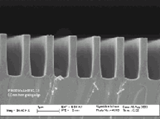
The grating equation applies to any and every type of diffraction grating. We use the following terminology:
Grating equation:
m · λ = Λ · (sin θI + sin θD)
where:
m is the m’th diffraction order
λ is the wavelength of the illumination
Λ is the grating period
θI is the incidence angle of the illumination
θD is the diffraction angle of the illumination for the m’th diffraction order,
with respect to the following schematic: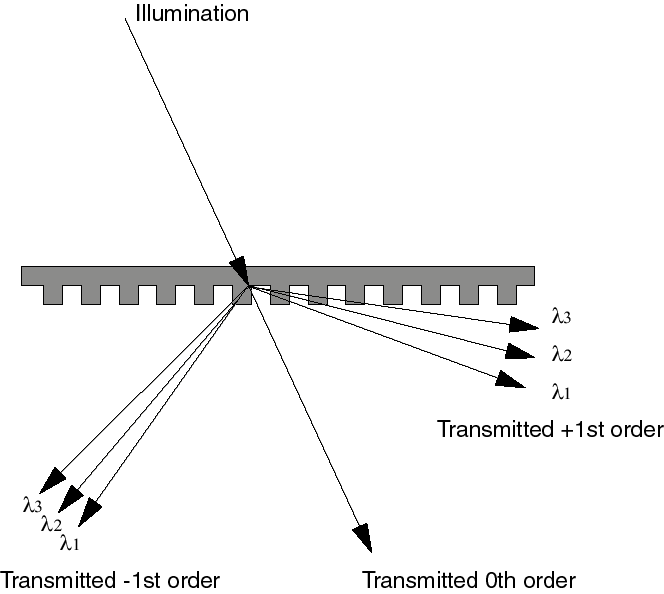
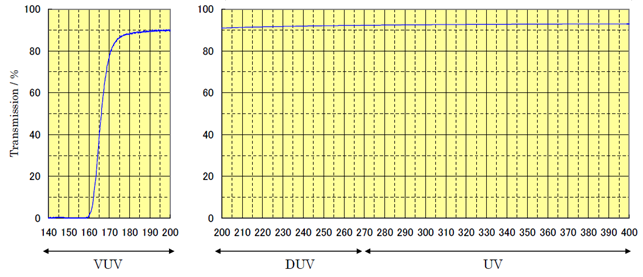
We make gratings for the entire transmission range of fused silica, which starts below 200 nm and goes beyond 2000 nm. The plot below show the UV applicability of UV grade fused silica material (and thus UV fused silica transmission gratings) – here shown as the external transmission (i.e. there is approx. 8% surface Fresnel reflection loss) of a 6.35 mm thick substrate.
General questions about environmental qualification
Yes we are. You can read more about our quality management, ISO Certifications and Compliance here.
Yes, we are qualified as a component supplier. You can read more about our quality management, ISO Certifications and Compliance here.
By default we typically use IEC 60068. But we are open to discuss other references per customer demand.
We typically perform storage temperature, operating temperature, damp heat, vibration and shock testing per 60068. See table here for an example. If required operating tests can also include varying atmospheric pressure and advanced shock.
We typically use 3 units but, the customer can request that more units are used.
These depend on the specific spectrometer and are often determined by the detector. Common ranges are 0°C – 50°C operating, but extended to -40°C to 75°C for special cases, and -40°C – +85°C storage, extended down to -55°C.
Ibsen’s OEM spectrometers are supplied as non‑IP‑rated optical modules intended for integration into the customer’s own enclosure. Environmental protection such as IP sealing, dust protection, or splash protection is provided by the customer’s instrument housing.
Want to know more?
For further information see below.