
OEM spectrometers for pharmaceutical instrumentation
What role does spectroscopy play in the pharmaceutical industry?
Spectroscopy plays a central role in the pharmaceutical industry, supporting everything from early‑stage drug discovery to large‑scale manufacturing. While the industry uses many analytical techniques – such as chromatography, mass spectrometry, thermal analysis, and microscopy – optical spectroscopy occupies a unique position because it provides rapid, sensitive, and non‑destructive measurements. As regulatory expectations increase and processes become more data‑driven, fast and reliable analytical tools are essential for ensuring product quality, safety, and consistency.
Optical spectroscopic techniques offer a combination of speed, sensitivity, and minimal sample preparation, making them ideal for monitoring critical quality attributes throughout the entire lifecycle of a drug.
Spectrometers form the core of all optical spectroscopy techniques used in the pharmaceutical industry. Whether the method is UV‑VIS, HPLC‑PDA, NIR, or Raman, the spectrometer is the component that ultimately determines measurement accuracy, sensitivity, and reliability. Because spectroscopy is used throughout the entire pharma value chain — from early R&D to manufacturing and QC — the spectrometer must deliver consistent, traceable performance that meets regulatory expectations.
Why are Ibsen’s spectrometers well suited for the pharmaceutical industry?
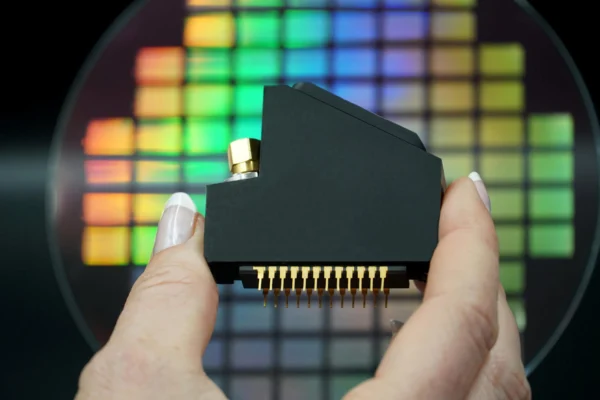
Ibsen offers spectrometers for UV-VIS, NIR and Raman well suited for integration into spectroscopy instruments for demanding pharmaceutical applications with the following benefits:
Which types of optical spectroscopy are used in pharmaceuticals?
A wide range of optical spectroscopic techniques supports analytical workflows across the pharmaceutical industry, each offering unique strengths for different stages of development and manufacturing.
Together, these optical techniques form the backbone of modern pharmaceutical analysis, supporting efficient development, robust process control, and reliable quality assurance.
How are optical spectroscopy instruments typically constructed?
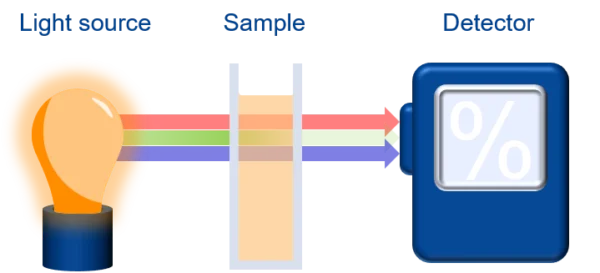
Most optical spectroscopy instruments used in pharmaceutical analysis share a common architectural structure with a light source, sampling interface, a spectrometer and a data analysis model.
Light source
The purpose of the light source is to provide consistent illumination across the wavelength range of interest.
Sampling interface
This is the part of the instrument that interacts with the material being measured. Its design varies widely depending on the application:
Spectrometer
The spectrometer is the subsystem that converts incoming light into a wavelength‑resolved digital signal — the spectrum. The overall accuracy and repeatability of an optical spectroscopy instrument depend heavily on the spectrometer’s spectral resolution, wavelength range, sensitivity, noise performance as well as how fast it can measure. These characteristics determine how reliably the instrument can detect, quantify, and track critical quality attributes in pharmaceutical applications.
Common spectrometer architectures used in optical instruments include:
Data analysis model
The model transforms the raw spectrum into parameters – such as concentration, identity, moisture content, blend uniformity – meaningful for the end-user.
Construction of optical spectroscopy instrument
Optical spectroscopy instruments go by different names
Optical spectroscopy instruments are referred to by different names depending on the context and the industry. In laboratory settings they are often called spectrophotometers, in system‑integration and OEM environments they are described as spectrometers or spectral analysis modules, and in pharmaceutical PAT applications they are frequently treated as spectroscopic subsystems embedded inside larger analytical platforms.
How do you select a spectrometer that is fit for intended use in pharmaceutical analysis?
The requirements for a spectrometer vary significantly depending on where it is used. The table below provides some general guidelines.
| Pharmaceutical application | Typical wavelength range | Required optical resolution | Other critical spectrometer requirements | Why this matters |
|---|---|---|---|---|
| UV-VIS assays | 190-800 nm | 1-2 nm | Low stray light | Assays depend on precise absorbance and photometric linearity |
| HPLC-PDA | 190-800 nm | 1-2 nm | Fast acquisition (10–80 Hz), low noise, high dynamic range | Narrow chromatographic peaks require fast, stable, low noise detection |
| NIR PAT | 900-1700nm 1100-2500nm | 8-16 nm | Low noise Long term stability | Chemometric models require precise, low noise detection. Instruments must withstand vibration, temperature changes, and continuous operation. |
| Raman raw material ID | Raman shift 100–3200 cm-1 | 4-10 cm-1 | High optical resolution Low noise | Raman peaks are generally narrow and signal weak requiring long integration time. |
The spectrometers we offer for the Pharmaceutical industry
Our UV‑VIS spectrometers are compact, high‑performance, and mechanically robust, making them ideally suited for integration into HPLC UV detectors and UV‑VIS spectrophotometers. Their small footprint, high‑speed acquisition, and industrial‑grade stability enable reliable operation even in demanding environments.
For Raman spectroscopy, we offer configurations suited for 532 nm, 785 nm and 830 nm laser excitation, supported by a several cooled detector options to match the requirements of different applications. Our Raman spectrometers are exceptionally sensitive thanks to the use of near‑100% efficiency transmission gratings.
Our NIR spectrometers are robust units optimzed for different applications, from cost-efficient, compact spectrometers for mass-deployment of spectral sensors to spectrometers with the highest sensitivity and best signal-to-noise ratio.
For more information about our spectrometers the various spectrometers for the various spectroscopic techniques please select below.
UV-VIS: UV (190-435 nm) | VIS (360-830 nm) | UV-VIS (190-850 nm)
NIR: NIR (900-2100 nm)
Raman: 532 | 785 | 830
More resources
Want to know more?
For further information see below.