
Visible light (VIS) spectroscopy
Why Ibsen Photonics for visible light spectroscopy
Visible light spectroscopy analyzes the reflected, transmitted, or absorbed light from a sample or source to determine its spectral characteristics across the visible range, typically spanning wavelengths from approximately 380 to 750 nanometers. This technique is widely used in applications such as color analysis, spectral characterization of light sources, material identification, chemical concentration measurements, and quality control in manufacturing. Because spectral features can be narrow and sensitive to environmental conditions, spectrometers must deliver high sensitivity and resolution to ensure accurate and reliable measurements.
Ibsen Photonics manufactures transmission gratings with the world’s highest diffraction efficiencies and high grating dispersion, enabling high sensitivity and resolution in compact, cost effective spectrometer designs.
Designed for volume manufacturing, with minimal unit-to-unit variation and high environmental stability, visible light spectrometers from Ibsen are ideal for integration in high performance systems at a competitive cost.
Ibsen Photonics makes a difference in your VIS spectroscopy system
Advantages of using Ibsen Photonics for visible light spectroscopy
Our spectrometers and in-house manufactured transmission gratings provide unparalleled sensitivity and best-in-class optical design optimized for throughput and resolution. We offer a variety of detector options for our spectrometers which, combined with our DISB low-noise electronics, ensure the highest possible signal-to-noise ratio in your instrument.
Spectrometers from Ibsen Photonics have no moving parts and are designed for low sensitivity to environmental influences, ensuring the long-term stability required for robust and accurate color measurements.
Our experienced R&D teams have over 200 years of combined tenure and experience optimizing grating and spectrometer designs to achieve the best possible performance in cost and size-effective platforms.
.
These factors yield the following benefits:
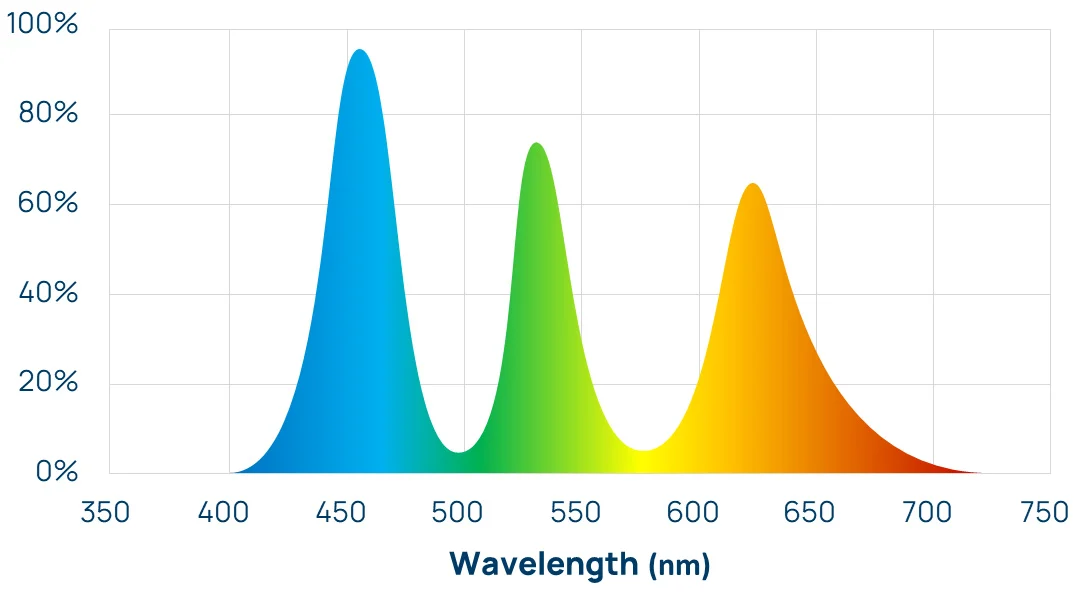
Graph illustrating a typical OLED color spectrum.
Transmission gratings for visible light
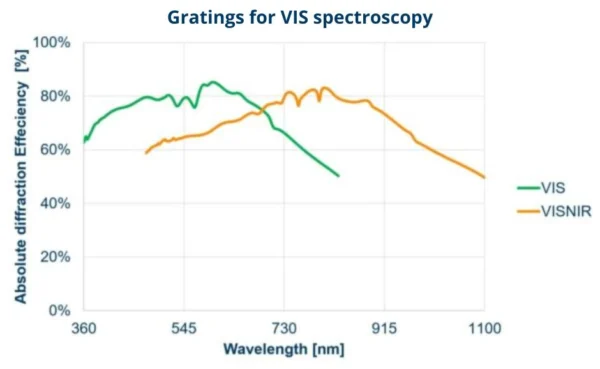
At Ibsen Photonics, we design and manufacture the world’s best surface relief transmission gratings in fused silica for wavelengths between 175 nm and 2500 nm. Diffraction efficiencies (DE) for a selection of our gratings in the UV-VIS-NIR spectrum are shown in the figure.
Advantages of using Ibsen transmission gratings for your spectrometer:
Spectrometers for visible light spectroscopy
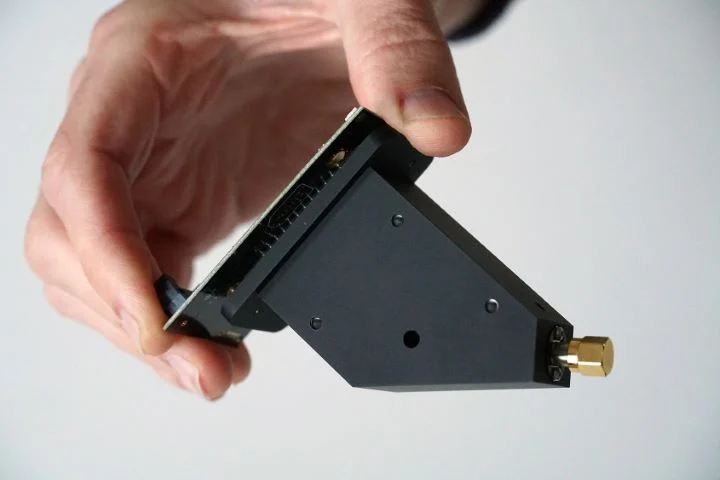
Our spectrometers can be used for a variety of applications utilizing visible light. Our models range from the ultra-compact PEBBLE-VIS to the wide-bandwidth FREEDOM UV-NIR and the highly sensitive ROCK VIS models.
We offer both TE-cooled and non-cooled detector options across several spectrometer models, allowing you to choose the detector technology that best suits your specific application. Additionally, all our detectors are equipped with our proprietary DISB electronics, ensuring low noise, fast data acquisition, and precise spectral readout.
If our standard spectrometer configurations do not fully meet your requirements, we are happy to collaborate on a customization project tailored specifically to your needs.
For more details on our range of spectrometers suitable for visible light spectroscopy, please select your preferred wavelength range.
Wavelength ranges: VIS (360-830 nm) | VIS-NIR (475-1100 nm)
More resources
Want to know more?
For further information see below.