
Environmental qualification of spectrometers for industrial and harsh environments
Environmental qualification of spectrometers is the process of demonstrating that an instrument maintains its optical performance when exposed to real‑world environmental stresses such as vibration, shock, temperature cycling, humidity, and long‑term aging. For OEM designers, qualification is essential because even small mechanical or thermal disturbances can shift optical alignment, change wavelength accuracy, reduce resolution, or degrade signal stability. This page explains why environmental qualification is required, what the process typically involves, how spectrometers react to external influences, and which design principles ensure robust, stable performance in industrial and harsh environments.
Why is environmental qualification required for spectrometers?
Optical instruments based on spectrometers are used in industrial, portable, and field applications where the surrounding environment can be unpredictable. In addition, instruments are typically manufactured in a single location and then transported to customers by land, sea, or air, exposing them to further environmental stresses during shipping.
Common environmental influences include:
- variations in ambient temperature,
- variations in relative humidity
- vibrations
- mechanical shocks/impacts
These factors can temporarily or permanently alter the performance of a spectrometer or—in the worst case—cause complete instrument failure.
Environmental qualification of spectrometers verifies that the instrument can withstand defined external influences while maintaining performance within acceptable limits. In this way, environmental qualification reduces the risk of field failures and associated RMA costs.
What does environmental qualification involve?
Environmental qualification of a spectrometer involves a series of tests performed on a limited number of units, typically during the final stage of product development. Some tests evaluate the spectrometer’s performance while it is operating under various environmental influences, whereas others are designed as accelerated lifetime tests to verify that the spectrometer can withstand specific external stresses over its expected service lifetime.
Typical parameters that are checked during and after environmental tests are:
- visible mechanical changes like detached or loose elements
- Shift in wavelength calibration
- Shift in spectral resolution
- Shift in sensitivity/ throughput
Thermal tests
During thermal tests, the spectrometer is placed in a temperature chamber and cycled between a lower and an upper temperature limit. These limits depend on the specific application and any referenced standards.
In general, thermal testing falls into three categories:
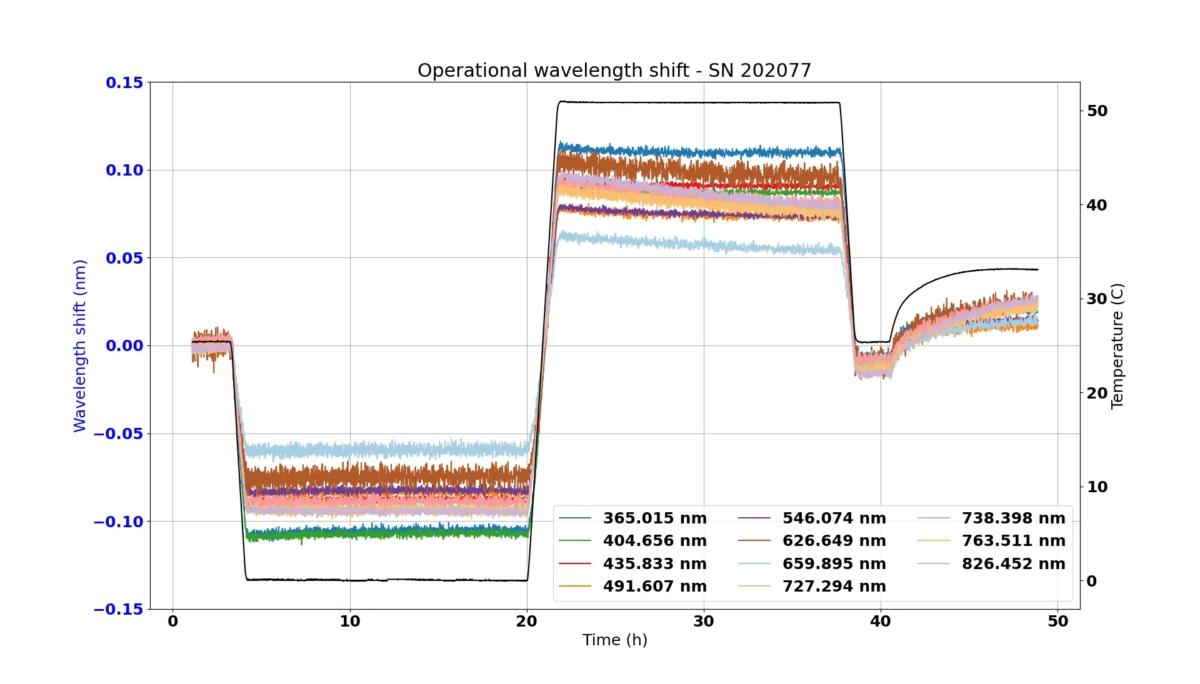
- Operating tests: The spectrometer is tested while operating within its defined temperature range to evaluate potential wavelength shifts or performance changes caused by temperature variations.
- Storage tests: The spectrometer is tested in a non‑operational state over a wider storage temperature range to verify that it can withstand typical temperatures encountered during transportation and storage.
- Accelerated lifetime tests: To simulate long term environmental stress—often equivalent to several years—the spectrometer is exposed to continuous temperature cycling to assess its ability to survive repeated thermal expansion and contraction over time.

Humidity tests
During humidity tests, the spectrometer is placed in a climate chamber where both temperature and relative humidity are controlled. Humidity exposure is relevant because condensation, high moisture levels, and cyclic damp‑heat conditions can influence materials, adhesives, coatings, and electronic components.
Humidity testing typically includes the following categories:
- Operating humidity tests: The spectrometer is operated within a defined humidity range to verify that optical performance remains stable when exposed to elevated moisture levels. In practice, operating humidity is often less critical because the electronics generate heat during operation, which reduces internal relative humidity and helps prevent condensation . Operating tests are therefore almost always non-condensing.
- Storage humidity tests: The spectrometer is exposed to high humidity in a non‑operational state to ensure that it can withstand moisture during transportation or long‑term storage. Without the self‑heating effect from electronics, materials, adhesives, and mechanical interfaces are more vulnerable to moisture absorption and degradation.
- Damp‑heat or condensation tests: To simulate real‑world environments where temperature and humidity fluctuate, the spectrometer is subjected to cyclic damp‑heat conditions. These cycles can lead to condensation inside the instrument, which is a critical stress factor for optical components and electronics. The test verifies that the spectrometer can tolerate repeated moisture exposure without long‑term performance loss.
Vibration tests
During vibration tests, the spectrometer is mounted on a vibration table and exposed to controlled mechanical excitation across all three axes (X, Y, and Z). The vibration profiles typically include sinusoidal vibrations with varying amplitude and frequency, as well as more complex random vibration patterns.
Vibration testing typically includes the following categories:
- Operating vibration tests: The spectrometer is operated while subjected to defined vibration profiles to verify that optical performance remains stable under mechanical excitation. This type of tests are typically required for handheld instruments.
- Non‑operating vibration tests: The spectrometer is exposed to vibration in a non‑operational state to simulate transportation and handling conditions.


Shock tests
To replicate real‑world scenarios such as accidental drops or impacts, the spectrometer is exposed to controlled shock pulses with defined acceleration and duration. These tests validate that the instrument can withstand extreme but plausible mechanical events without catastrophic failure.
Relevant standards for environmental qualification of spectrometers
Environmental qualification of spectrometers is typically performed with reference to established international standards that define how instruments should be tested under temperature, humidity, vibration, shock, and other environmental stresses. The relevant standards vary by application area—from general industrial and laboratory use to handheld instruments, transportation robustness, and the more demanding requirements found in military, aerospace, and space flight environments. The table below summarizes the most commonly referenced standards across these domains.
The standards marked with bold are the ones, Ibsen is testing against.
| Standard | Domain / application | What it covers |
|---|---|---|
| IEC 60068 series | Industrial, laboratory | Temperature cycling, humidity, vibration, shock, mechanical stress |
| IEC 60721 | Industrial, transport | Classification of environmental conditions for operation, storage, and transport |
| ISO 9022 | Optical instruments | Environmental tests specifically for optical devices (temperature, humidity, mechanical stress, solar radiation) |
| ASTM (various) | Industrial | Methods for vibration, shock, humidity, temperature exposure |
| IEC 60529 (IP ratings) | Handheld, outdoor | Dust and water ingress protection |
| ISTA 1/2/3 series | Transport, packaging | Vibration, shock, drop tests for packaged products |
| MIL STD 810 | Military, aerospace, rugged industrial | Temperature, humidity, vibration, shock, altitude, sand/dust, freeze thaw, more |
| MIL STD 202 | Military electronics | Vibration, shock, moisture, thermal shock for electronic components |
| MIL STD 883 | Microelectronics | Environmental tests for detectors and electronic assemblies |
| RTCA DO 160 | Aviation | Environmental conditions for airborne equipment (vibration, shock, temperature, humidity, altitude) |
| NASA GEVS | Space hardware | Vibration, shock, thermal cycling, radiation for space flight instruments |
Although many environmental standards exist across industrial, handheld, military, and aerospace applications, most of them inherit test concepts from one another. As a result, the underlying test methods—such as temperature cycling, damp‑heat exposure, sinusoidal and random vibration, or mechanical shock—are often very similar. What differs between standards is typically the severity of the test conditions, the required documentation, and the environmental assumptions for the intended application. This means that while IEC 60068, ISO 9022, MIL‑STD‑810, and DO‑160 originate from different domains, they share a common foundation of environmental test principles.
Most environmental standards do not define specific performance limits for spectrometers. Instead, they describe how environmental tests must be performed—including temperature ranges, humidity levels, vibration profiles, shock pulses, and test durations. The manufacturer is responsible for defining acceptable performance criteria during and after testing, such as wavelength stability, resolution stability, or throughput. Standards like IEC 60068, ISO 9022, MIL‑STD‑810, and DO‑160 therefore provide the test conditions, while the spectrometer’s required performance under those conditions is determined by the intended application.
How do spectrometers react to external environmental influences?
Spectrometers are built by combining optical, electronic, and mechanical components using adhesives and/or mechanical mounting techniques. Because the materials used in these assemblies expand and contract differently with temperature, the joints between them can experience mechanical stress during temperature cycling. Similar stresses can accumulate during repeated vibration or shock exposure. Over time, these stresses may lead to gradual misalignment of internal components or, in severe cases, complete joint failure. Adhesives are polymers, and their chemical structure can change under elevated temperature or high relative humidity, which may further contribute to misalignment or weakened joints.
Misalignment of internal components typically causes the spectrometer to lose wavelength calibration, alter its spectral resolution, or reduce its sensitivity. It is important to distinguish between reversible and irreversible changes. Reversible changes are sometimes less critical because they can be controlled, for example, by maintaining the spectrometer at a stable operating temperature. Irreversible changes are more severe and often indicate that a component or joint inside the spectrometer is degrading and may soon fail.
The most sensitive electronic component in a spectrometer is often the detector, which is a semiconductor chip mounted on a ceramic substrate and encapsulated in a housing made from plastic, ceramic, or metal. The detector’s signal and noise performance depend strongly on temperature, making it particularly important to manage thermal conditions during operation.
How do you design a spectrometer that remains robust under environmental stress?
Spectrometer environmental robustness begins in the design phase by selecting appropriate materials and mounting methods. Optical glasses typically have a much lower coefficient of thermal expansion than most plastics and metals. This mismatch can be reduced by using low‑expansion alloys such as INVAR or KOVAR, which more closely match the thermal behavior of glass. However, these materials are significantly more expensive and more difficult to machine than common metals such as aluminium.
An alternative approach is to design the opto‑mechanical structure so that materials are allowed to move relative to each other in a controlled way. When adhesives are used, it is important to consider whether soft, compliant adhesives or hard, rigid adhesives are appropriate. Soft adhesives can absorb differential expansion and reduce stress transfer, while hard adhesives provide higher stiffness but may transmit more stress to the optical components.
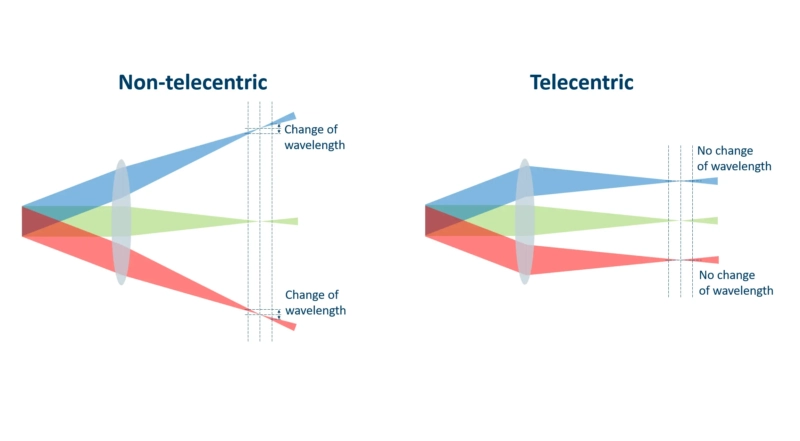
The optical design itself also influences how sensitive the spectrometer is to misalignment. In general, telecentric and circularly symmetric optical architectures are less prone to performance degradation when components shift slightly. A crucial part of any spectrometer development process is the tolerance analysis, where wavelength calibration, spectral resolution, and throughput are evaluated under a wide range of axial, lateral, and angular misalignments of the optical components.
Finally, it is important to select a detector that is specified to withstand the environmental conditions relevant for the spectrometer. Condensation on the detector’s surface and cover glass can occur if the spectrometer is operated below the ambient dew point, which can lead to temporary loss of signal or long‑term damage. This risk can be mitigated by choosing a sealed detector package filled with an inert gas such as argon, or by using a detector with active temperature control. Maintaining the detector at a fixed temperature ensures stable responsivity and noise performance during operation.
What are the key things to consider when evaluating environmental robustness or qualification?
The environmental qualification requirements for a spectrometer are derived from its intended use case. It is important to avoid over‑specifying these requirements, as unnecessarily harsh environmental tests will almost certainly increase the cost of the spectrometer without providing meaningful benefit.
Even when the spectrometer is designed for robustness, it is crucial that production follows well‑defined manufacturing processes under a quality‑controlled framework such as ISO‑9001. Adhesive mixing, curing, and mechanical assembly are examples of processes that can strongly influence the final robustness of the product.
Environmental qualification is typically performed as one of the final stages of product development. It is essential that the units used for qualification are identical to normal production units, including materials, adhesives, assembly methods, and calibration procedures.
More resources
Want to know more?
For further information see below.