
NA to f-number converter
Numerical aperture (NA) and f-number (F/#) are commonly used to describe the light-gathering capability of optical systems. In spectrometer design, converting between NA and f-number is often required when matching optical fibers, lenses, and spectrometer inputs to maximize optical throughput. Use the NA to f-number converter below to quickly convert between numerical aperture and f-number.
What are numerical aperture and f-number?
The NA to f-number converter converts between two optical parameters that describe the angular acceptance of an optical system. Numerical aperture (NA) is typically used to characterize optical fibers, while f-number (F/#) is more commonly specified for lenses, cameras, and spectrometers.
Although they are expressed differently, numerical aperture and f-number describe the same fundamental optical property. A larger acceptance angle results in a higher numerical aperture and a lower f-number, allowing the optical system to collect light over a wider range of angles.
Learn more about how throughput and sensitivity of spectrometers are related to NA and f-number in our extensive white paper “Understanding throughput in spectrometers”.
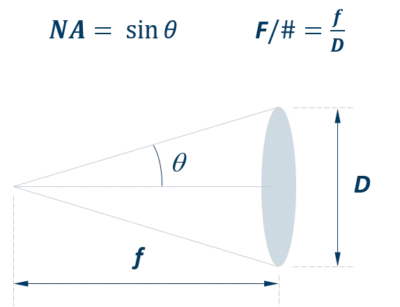
NA and f-number conversion formulas
The relationship between NA and f-number is often given in the case where the top angle θ is small. This corresponds to small NA or large f-number. I this limit, tanθ ≈ sinθ which give us:
| D/2 | = tanθ ≈ sinθ = NA |
| f |
and therefore the following approximate formulas
| F/# ≈ | 1 | and | NA ≈ | 1 |
| 2NA | 2F/# |
Even with moderate NA and f-numbers the error in the approximate formulas will be visibale. So for the NA to f-number converter on this page we are using the accurate formulas:
| F/# = 0.5 · √(1/NA² – 1) | and | NA = 1 / √(4(F/#)2 + 1) |
Want to know more?
For further information see below.