
What is visible light (VIS) spectroscopy?
Visible light spectroscopy is a powerful analytical technique for examining how materials interact with light in the spectrum visible to the human eye, typically spanning wavelengths from 380 to 750 nanometers. By analyzing the light that is reflected, transmitted, or absorbed by a sample, this method provides valuable insights into properties such as color, composition, structure, and overall optical behavior.
Unlike measurements based on just a few discrete wavelengths – such as RGB or narrowband filters – visible light spectroscopy captures the full spectral distribution, enabling precise analysis of subtle variations across the entire visible range. This makes it indispensable in fields such as color quality control, light source characterization, material analysis, environmental sensing, and biomedical diagnostics.
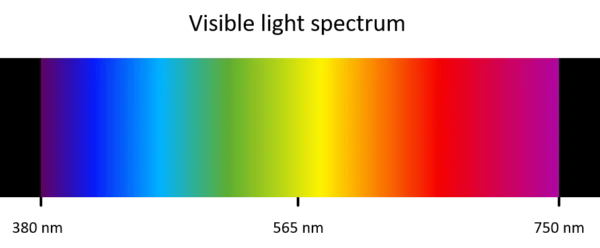
The principles of visible light spectroscopy
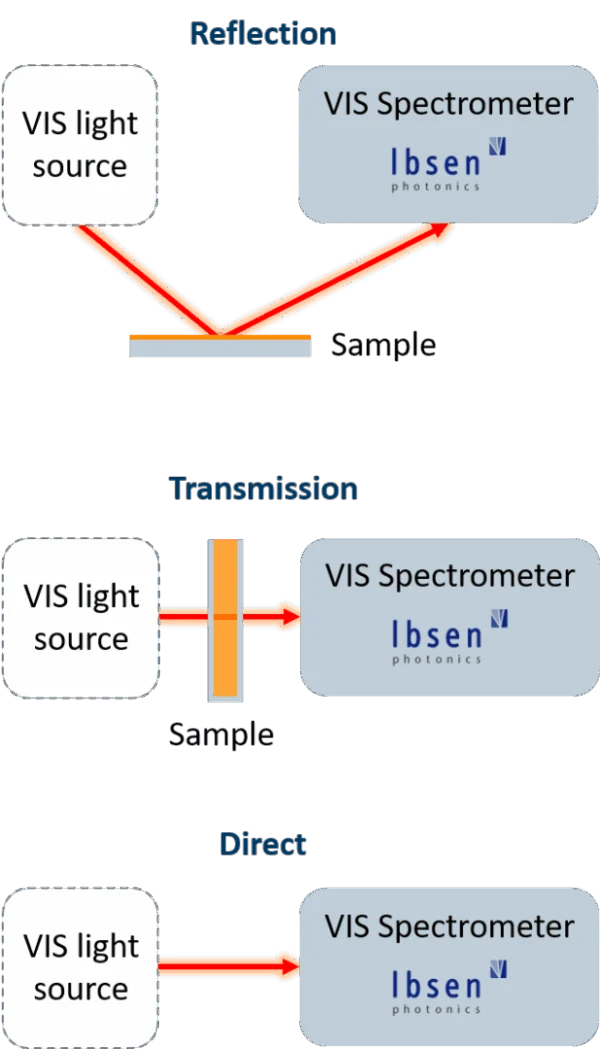
Visible light spectroscopy involves analyzing how light interacts with a sample. This may include measuring how the sample alters incoming light or directly examining the light it emits. The technique is typically applied in three main scenarios, depending on whether the light is reflected from the sample, transmitted through it, or emitted directly by the light source.
Reflection: In reflection-based measurements, a controlled light source – such as a halogen lamp or LED – is used to illuminate the sample. Typically, both the reflected spectrum of a reference white sample and that of the actual sample are recorded. By dividing the sample spectrum by the reference spectrum, the measurement becomes independent of the specific light source used. This setup is commonly employed to analyze the color of surfaces.
Transmission: In transmission measurements, light from the source passes through the sample. A reference spectrum can be obtained by either removing the sample or replacing it with a transparent material. This method is widely used in chemical analysis of fluids to determine the concentration of constituents in a solvent. In such cases, the blank reference sample is the pure solvent.
Direct: In emission-based measurements, the light source itself emits the spectrum to be analyzed. Examples include LEDs, displays, flames, and bioluminescent materials. The spectrometer directly examines the emission spectrum to determine properties such as spectral power distribution, peak wavelengths and bandwidth, and color temperature or chromaticity. This approach is essential for characterizing light-emitting sources, monitoring chemical reactions, and assessing display technologies.
VIS spectroscopy instrumentation
A system designed for measuring visible light typically consists of four main components: a light source, a spectrometer, a sample holder, and system software that converts the measured spectrum into application-specific information.
Light source
Typical light sources used in visible (VIS) spectroscopy include white LEDs, halogen lamps, xenon flash lamps, and fluorescent lamps. Fluorescent lamps, in particular, tend to exhibit flickering caused by 50 Hz or 60 Hz oscillations in the supply voltage. While this flickering is often imperceptible to the human eye, it can be detected by cameras and spectrometers.
Spectrometer
Spectral data is captured by a spectrometer, which employs a diffraction grating to spatially separate the different wavelengths of light. A silicon-based detector then converts the optical intensity at each wavelength into electrical signals.
Sample holder
In many applications, measurement results are affected by both the distance and the observation angle between the sample and the spectrometer. In color measurements for example, geometries are standardized by organizations such as the International Commission on Illumination (CIE) and ASTM to ensure that results are consistent and reproducible across different instruments and environments. To maintain accuracy and repeatability, it is essential to use robust and often adjustable sample holders that allow precise control over positioning and alignment during measurement.
System software
In most applications, the goal is to measure specific characteristics of the sample. To achieve this, the raw spectral data must be converted into more practical parameters, such as CIE Lab*, RGB values, and chromaticity coordinates, or the concentration of chemical constituents. This conversion is carried out by the system software, which processes the spectral data and translates it into meaningful, application-specific information.
Applications of VIS spectroscopy
Visible light spectroscopy is employed across a broad and diverse range of applications. One of its most prominent uses is in color measurement, which plays a critical role in industries such as graphic printing, flat-screen displays, textiles, and paints. Additionally, biomedical analysis of tissue and blood samples represents another important area where visible light spectroscopy is widely applied.
For a detailed overview of the various applications of visible light spectroscopy, click here.
More resources
Want to know more?
For further information see below.