
The ultimate guide to spectrometer integration
Selecting and integrating an OEM spectrometer into a spectroscopic instrument requires multidisciplinary expertise across several engineering disciplines, including optics, mechanics, electronics, and software development. Gaining deep expertise in all of these areas can be challenging, making it difficult to evaluate which spectrometer solution is best suited to your application. This eBook breaks the key design choices down into simple, actionable guidance, helping you make informed decisions and accelerate the development of your instrument.
Basics of spectroscopy instrumentation
Spectroscopy is used to identify and quantify the constituents of a sample. This can be the number of active
ingredients in a pharmaceutical tablet, the protein content of harvested grain, or the atomic content of a rock sample on Mars.
There are many different techniques used for spectroscopy and in this guide, we limit ourselves to optical spectrometers typically used for molecular spectroscopy. This means that our instrument will use light to analyze the sample. The main benefit of using light for spectroscopy is that it can provide fast (often real-time) results without destroying or interfering with the sample.
A spectroscopic instrument records the spectrum being emitted from, reflected off, or transmitted through a sample. An example of an emitted spectrum is the light coming from the color screen of your mobile phone. The colors you see on the screen are constructed by mixing red, green, and blue light from a lot of small light sources inside the screen. When you have equal amounts of red green and blue our eyes see it as white light but, if we analyze it with a spectrometer we can clearly see the three distinct wavelength peaks.
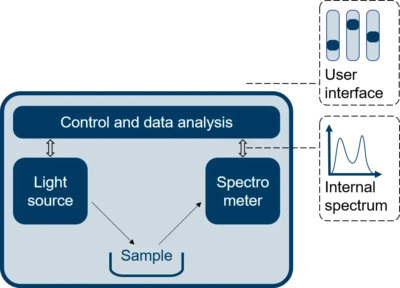
A spectroscopy instrument generally contains the basic elements shown in Figure 1 inside the dashed box. A light source to illuminate the sample, a spectrometer to record the spectrum, and a software model to convert the spectrum into useful information for the end-user.
Download the full eBook:
Are you curious to learn more about:
Which light source to choose?
Selecting the right light source is a critical part of instrument design, although the application itself will often determine the most appropriate choice. In some cases, no light source is required because the sample is self-emitting, such as display screens, lamps, or other light-emitting objects. In other applications, ambient illumination from the sun or indoor lighting can be utilized, eliminating the need for an integrated source, although the measurement method must be robust against variations in light intensity and spectral content. When active illumination is required, broadband light sources such as deuterium, tungsten-halogen, or xenon lamps are commonly used for absorption measurements and applications that span a wide spectral range. For measurements focused on a narrower wavelength region, LEDs offer a compact, energy-efficient, and cost-effective solution. Some techniques, including fluorescence, Raman, and laser-induced breakdown spectroscopy, require even narrower excitation sources, typically LEDs or lasers.
Which spectrometer to choose?
Together with the light source, the spectrometer determines the optical performance of your spectroscopic instrument. The basic function of a spectrometer is to detect the intensity of light as a function of wavelength.
How a spectrometer works
A spectrometer uses a diffraction grating to separate the incoming light into its constituent wavelengths and a detector array to convert the light intensity at each wavelength into electrical signals that can be processed by conventional electronics. In addition, a spectrometer typically includes an entrance slit, along with a combination of lenses and/or mirrors that collect, focus, and direct the light through the optical system.
Key parameters to consider for specifying a spectrometer
The two most important parameters to consider when specifying a spectrometer are the wavelength range and the spectral resolution. The wavelength range determines the span of the spectrum required for your application, for example 400-750 nm for visible-light measurements, while the spectral resolution determines how closely spaced spectral features can be distinguished. In general, it is important to select specifications that match your application requirements rather than overspecifying performance, as unnecessarily stringent specifications can increase system complexity and cost without providing additional benefits.
Spectrometer size and cost
Compactness has become an increasingly important consideration in instrument design. This is driven both by the growing demand for handheld instruments that are easy to carry and operate, and by the need to fit more equipment into limited laboratory space. The size of a spectrometer is determined primarily by the dispersion required from the grating and the physical length of the detector array.
Cost is, of course, another key consideration, as instrument designers must balance performance against overall system cost. As a general rule, smaller spectrometers with uncooled detectors tend to be more cost-effective than larger systems equipped with cooled detectors. It is therefore important to select specifications that meet the application’s requirements without adding unnecessary complexity or expense.
Other parameters to consider
In addition to wavelength range, spectral resolution, size, and cost, many other factors must be considered when selecting a spectrometer. These include measurement speed, sensitivity, robustness, and environmental requirements, among others. Download our eBook to learn more.