
High performance transmission gratings for WSS modules in AI data centers
By Kristian Buchwald, Ibsen Photonics
Introduction
Artificial intelligence (AI) is reshaping the architecture of modern data centers. AI workloads generate dense, continuous east–west traffic between GPUs, creating throughput and latency demands far beyond those of traditional client–server applications such as video streaming. As these GPU clusters scale, the optical interconnects that bind them must deliver high capacity, low PDL, and deterministic performance under all operating conditions.
To secure power, cooling, and redundancy, operators increasingly distribute AI workloads across multiple sites. Linking these facilities requires optical connections capable of transporting terabit‑scale traffic over distances well beyond the reach of electrical or short‑range optical cabling. Dense Wavelength Division Multiplexing (DWDM) networks have become the backbone of these regional AI clusters, with wavelength selective switches (WSS) providing the dynamic routing and spectral flexibility needed to balance load and maintain service continuity.
One of the key WSS components is the wavelength‑separating element whose efficiency, stability, and polarization behavior directly determine overall switch performance. This white paper examines high‑performance transmission gratings as the wavelength-separating element in WSS modules for AI data centers. With wafer‑scale manufacturing, high diffraction efficiency, ultra‑low PDL, and exceptional environmental robustness, Ibsen’s fused‑silica transmission gratings offer a reliable solution for scalable, high‑capacity optical interconnects in AI‑driven networks.

Data center interconnect (DCI) requirements for AI
The physical reach and bandwidth of interconnect technologies determine how far AI clusters can be extended while still functioning as a unified system. Short reach links such as electrical Direct Attach Cables (DAC) support only a few meters, and Active Optical Cables (AOC) extend this to roughly ten meters. These technologies are ideal for server to GPU or rack to rack connections but cannot support communication between buildings or campuses.
AI deployments that span tens of kilometers rely on DWDM networks. DWDM provides the optical reach and aggregate capacity needed to interconnect distributed GPU clusters over dedicated dark fiber or shared telecom infrastructure. Modern DCI systems routinely operate at 400G and 800G per wavelength, with 1.6T channels emerging to support the next generation of AI workloads.
These long reach, high capacity links form the backbone of regional AI infrastructure. Their performance depends on optical components that can route wavelengths efficiently, maintain low loss, and operate reliably under demanding conditions — making the design of WSS modules and their internal optical elements increasingly critical.
The role of Wavelength Selective Switches in AI scale DCI
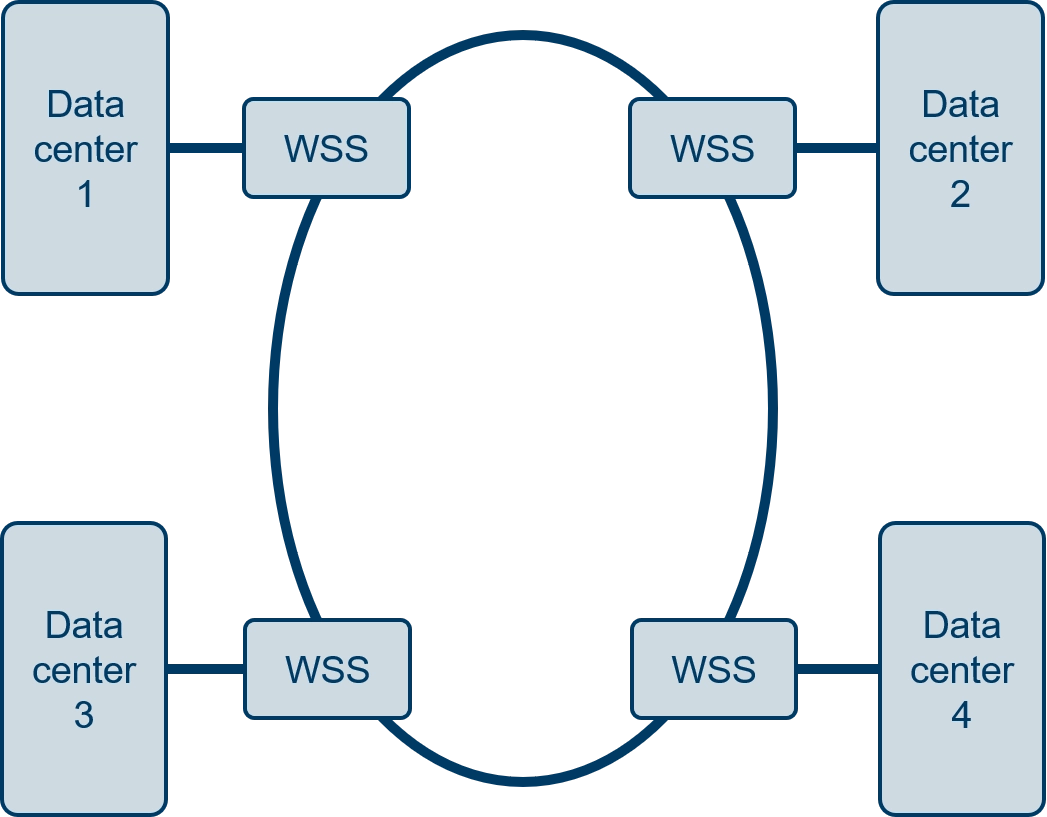
This figure shows how 4 data center sites are interconnected using a ring network with one WSS for each data center. The WSSs enable:
- Dynamic wavelength allocation — redistributing capacity as GPU clusters scale up or rebalance.
- Low latency optical routing — maintaining responsiveness by avoiding electrical–optical conversions.
- Topology flexibility — supporting ring, mesh, and hybrid architectures that allow multiple sites to operate as a unified compute region.
As AI clusters grow, operators frequently add new sites, new fiber paths, and new external ports. Each additional node requires additional WSS modules to integrate seamlessly into the regional optical fabric. This makes WSS scalability — the ability to deploy many identical, high performance switches — a foundational requirement for AI scale interconnects. In effect, the WSS is the network’s control plane in optical form, aligning high capacity DWDM links with the real time behavior of distributed AI workloads.
Performance requirements for WSS components for AI data centers
The optical components inside a WSS must meet stringent performance targets to support terabit class interconnects. As port speeds advance toward 800G and 1.6T, even small degradations in optical quality can reduce reach, impair coherent modulation formats, or limit the number of nodes that can be added to the network.
Key requirements include:
- Low insertion loss — preserving optical power across long reach DWDM links and enabling multi node topologies without excessive amplification.
- Low polarization dependent loss (PDL) — ensuring stable performance for coherent transmission formats, which are highly sensitive to polarization fluctuations.
- High environmental stability — maintaining consistent behavior across temperature swings, humidity, and long term field deployment.
Because operators may deploy many WSS modules as AI networks expand, performance consistency becomes just as important as absolute performance. The dispersive element inside the WSS — responsible for separating wavelengths — is therefore a critical design choice. Its optical efficiency, polarization behavior, and manufacturability directly determine how easily the network can scale.
Inside a Wavelength Selective Switch
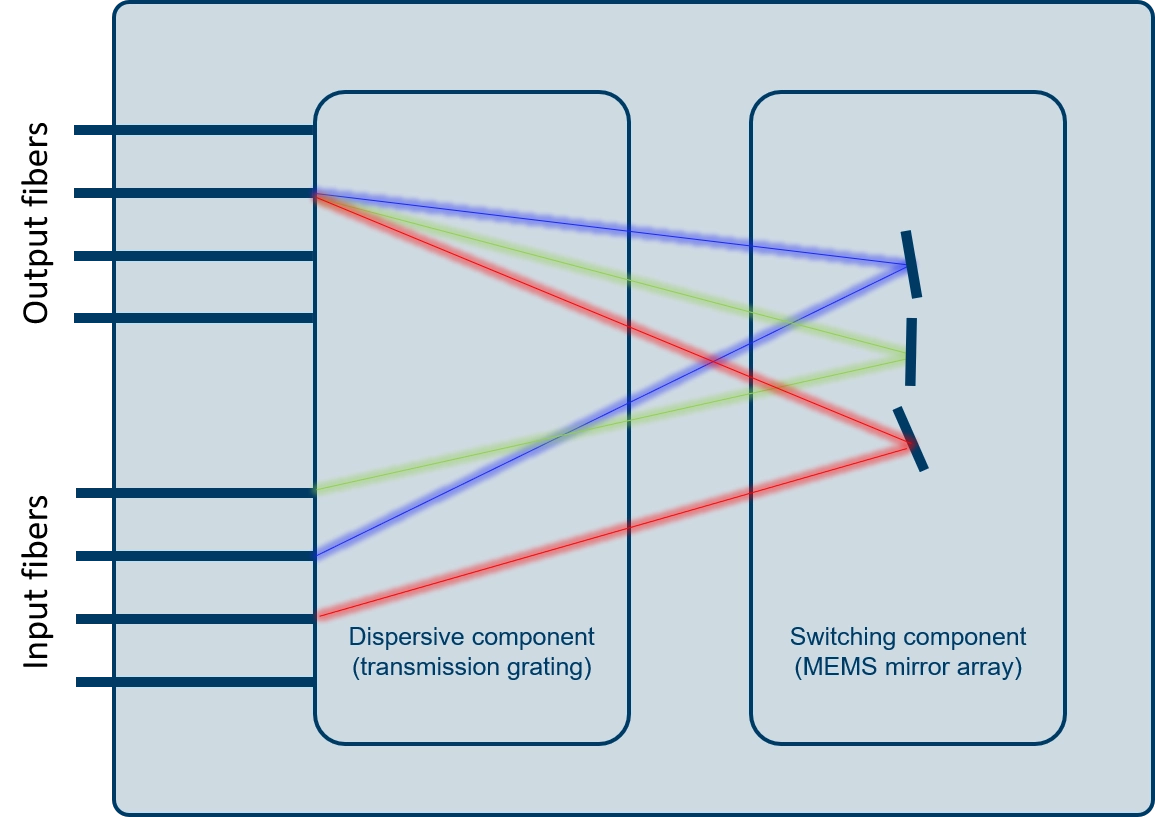
Although implementations vary, most WSS architectures share a common optical layout:
- Input and output fiber arrays — carrying multiple DWDM channels into and out of the switch.
- A dispersive element — separating wavelengths spatially so they can be individually routed.
- MEMS mirrors or similar actuators — directing each separated wavelength toward the desired output port.
The dispersive element is the heart of the WSS. It defines how cleanly wavelengths are separated, how much loss is introduced, and how stable the system remains under varying polarization and environmental conditions.
Why Ibsen Transmission Gratings are ideal for WSS
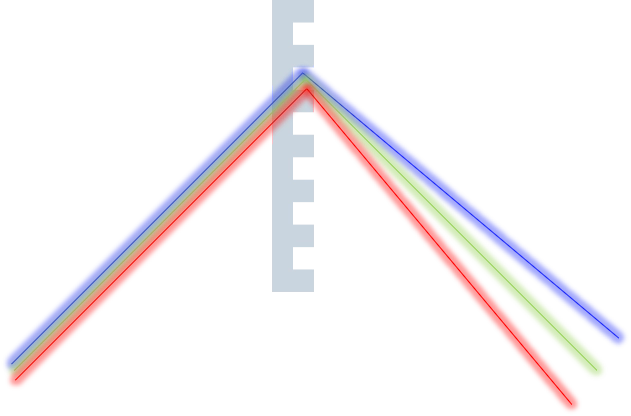
Ibsen’s transmission gratings are surface-relief structure etched into the surface of a fused silica substrate. By carefully designing the detailed grating profile we enable very high absolute diffraction efficiency for both TE and TM polarization.
The high optical performance is combined with manufacturing scalability, making them particularly well suited for WSS modules deployed in growing AI interconnects:
- Wafer based volume production Each wafer contains hundreds of identical gratings, enabling thousands of units to be produced with tight performance uniformity. This consistency is essential when operators scale their networks by adding more WSS modules at new ports or new sites.
- Very low loss with absolute diffraction efficiency above 95% High diffraction efficiency minimizes insertion loss inside the WSS, preserving optical power across long reach DWDM links and supporting multi node topologies without excessive amplification.
- Ultra low polarization dependent loss (<0.1 dB) The fused silica, surface etched structure provides inherently low PDL, ensuring stable performance for coherent modulation formats used in 400G, 800G, and 1.6T channels.
- Exceptional environmental robustness Ibsen’s gratings are etched into the surface of hard-coated fused silica and maintain stable performance under temperature cycling, humidity, and mechanical stress — critical for WSS modules deployed in large, distributed AI networks.
By combining efficiency, stability, and manufacturing repeatability, Ibsen’s transmission gratings strengthen the WSS at its most sensitive optical stage. This enables operators to scale their DWDM based AI interconnects confidently, adding new nodes and new WSS modules without sacrificing performance. In high capacity, latency critical AI environments, this reliability becomes a foundational advantage.
Want to know more?
For further information see below.