
Pulse compression calculator
Pulse compression and pulse stretching are essential techniques in ultrafast laser systems, enabling femtosecond lasers to deliver high pulse energies while maintaining excellent beam quality and long-term stability. These functions are commonly implemented using fused silica transmission gratings, which provide high efficiency, low loss, and exceptional reliability.
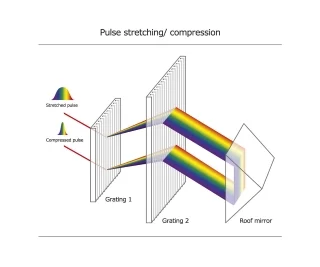
In a typical pulse compressor or pulse stretcher, two gratings are arranged in a double-pass configuration, as illustrated below. The performance of the system is primarily characterized by its Group Delay Dispersion (GDD) and Third-Order Dispersion (TOD). These parameters depend on the laser wavelength, grating groove density, grating separation, and the angle of incidence (AOI) on the first grating.
Use the Pulse Compression Calculator below to calculate the GDD and TOD of your grating-based pulse compressor or pulse stretcher. The calculator helps laser engineers and system designers quickly evaluate dispersion characteristics and optimize the performance of ultrafast laser systems.
Pulse compression theory
Pulse compression and pulse stretching are fundamental techniques in ultrafast laser systems. By introducing a controlled amount of chromatic dispersion, a pulse can be stretched before amplification and subsequently recompressed to near its original duration. This approach, known as Chirped Pulse Amplification (CPA), enables femtosecond lasers to achieve high peak powers while avoiding damage to optical components during amplification.
Transmission grating pulse compressors and stretchers typically consist of two diffraction gratings arranged in a double-pass geometry. Because different wavelength components travel different optical path lengths through the system, the pulse experiences wavelength-dependent delay, commonly described by the Group Delay Dispersion (GDD) and Third-Order Dispersion (TOD).
Group Delay Dispersion (GDD)
| GDD = | λ3LG2 | ; | X = λG – sin(α) | |
| πc2(1 – X2)3/2 |
where:
- λ is the laser wavelength
- L is distance between the gratings
- G is grating groove density
- c is the speed of light
- α is the AOI
A larger grating separation increases the magnitude of the GDD, resulting in stronger pulse stretching or compression.
Third-Order Dispersion (TOD)
While GDD governs the overall pulse duration, Third-Order Dispersion becomes increasingly important for ultrashort pulses, particularly below 100 fs. Excessive TOD can introduce pulse asymmetry, temporal sidelobes, and incomplete pulse compression.
For a grating pair, the TOD is:
| TOD = | 3λ4LG2 | 1 – Xsin(α) | ; | X = λG – sin(α) | ||
| 2π2c3 | (1 – X2)5/2 |
The TOD increases with grating separation and wavelength and becomes a critical design parameter when optimizing high-performance femtosecond and ultrafast laser systems.
Want to know more?
For further information see below.