
UV-VIS spectrometer instrumentation: principles, components, and design considerations
Designing UV‑VIS spectrometer instruments often requires expertise across several very different disciplines. Light sources, sampling optics, spectrometer design, detectors, and electronics each come with their own constraints, trade‑offs, and failure modes, and it is rare for a single developer to be deeply familiar with all of them. This page is intended to bridge that gap by providing a structured overview of the most important considerations in each subsystem, highlighting the interactions that matter most for absorbance accuracy, baseline stability, and long‑term repeatability. The goal is not to replace specialist knowledge, but to give instrument designers a clear, coherent foundation for making informed decisions across the entire optical chain.
How UV‑VIS instruments work
A UV‑VIS spectrometer instrument measures how a sample absorbs light at specific wavelengths, each corresponding to characteristic electronic transitions in the molecules being analyzed. The concentration of the analytes can then be derived using the Beer–Lambert law.
Inside the instrument light from a stable light source is directed through a controlled sampling interface and the spectral content of the transmitted light is afterwards dispersed across a linear array of photo-detectors in a spectrometer. Achieving reliable measurements requires careful coordination of illumination, optical throughput, and detector timing, as well as optical materials that maintain high transmission in the ultraviolet.
Ibsen supports instrument developers across this entire optical chain with compact, high‑sensitivity spectrometer modules optimized for UV‑VIS integration. Our fused‑silica transmission gratings deliver strong UV efficiency and inherently low stray light, while our detector and electronics options allow developers to match SNR, timing performance, and readout requirements to their application. Performance can be enhanced further with optional order‑sorting filters, spectral‑flattening filters, and cylindrical lenses that improve sensitivity and spectral uniformity.
Naming confusion in UV‑VIS spectrometer instrumentation
UV‑VIS terminology is often used inconsistently across industries and applications. In some contexts, the combination of light source, sample interface and spectrometer is referred to as a UV detector. In other cases, the entire instrument, including electronics and software, is called a spectrometer or spectrophotometer. Even though these terms overlap, they describe different levels of integration.
To avoid ambiguity on this page, UV‑VIS spectrometer instrumentation refers to the complete optical chain:
light source → sampling interface → spectrometer → detector → electronics.
Key performance parameters in UV-VIS spectrometer instrumentation
Defining the performance targets of a UV-VIS instrument is essential before selecting its sub modules. Parameters such as wavelength range, spectral resolution, linearity, stray light, timing accuracy, and allowable absorbance error determine the analytical capability of the system and guide the choice of light source, spectrometer optics, detector technology, and electronics.
Wavelength range
The wavelength range is determined by the combined behavior of the light source, optical materials, grating efficiency, and detector sensitivity. UV operation requires fused‑silica optics and detectors with strong UV quantum efficiency, while visible and NIR coverage depends on lamp selection and grating dispersion. A well‑balanced instrument maintains stable throughput across the full range to ensure consistent absorbance accuracy. Although the term “UV‑VIS” suggests broad coverage, many applications only require the 200–400 nm UV region. UV-VIS spectrometer instrument performance can often be improved by selecting components optimized specifically for the wavelength range actually used.
Spectral resolution and bandwidth
Spectral resolution is governed by slit width, grating dispersion, and the optical magnification of the spectrometer. Pharmacopeia guidelines recommend that the spectral bandwidth be no more than 10% of the narrowest peak that must be resolved. Higher resolution improves peak separation but reduces throughput, so the chosen bandwidth must balance sensitivity, SNR, and measurement speed.
Linearity and stray light performance
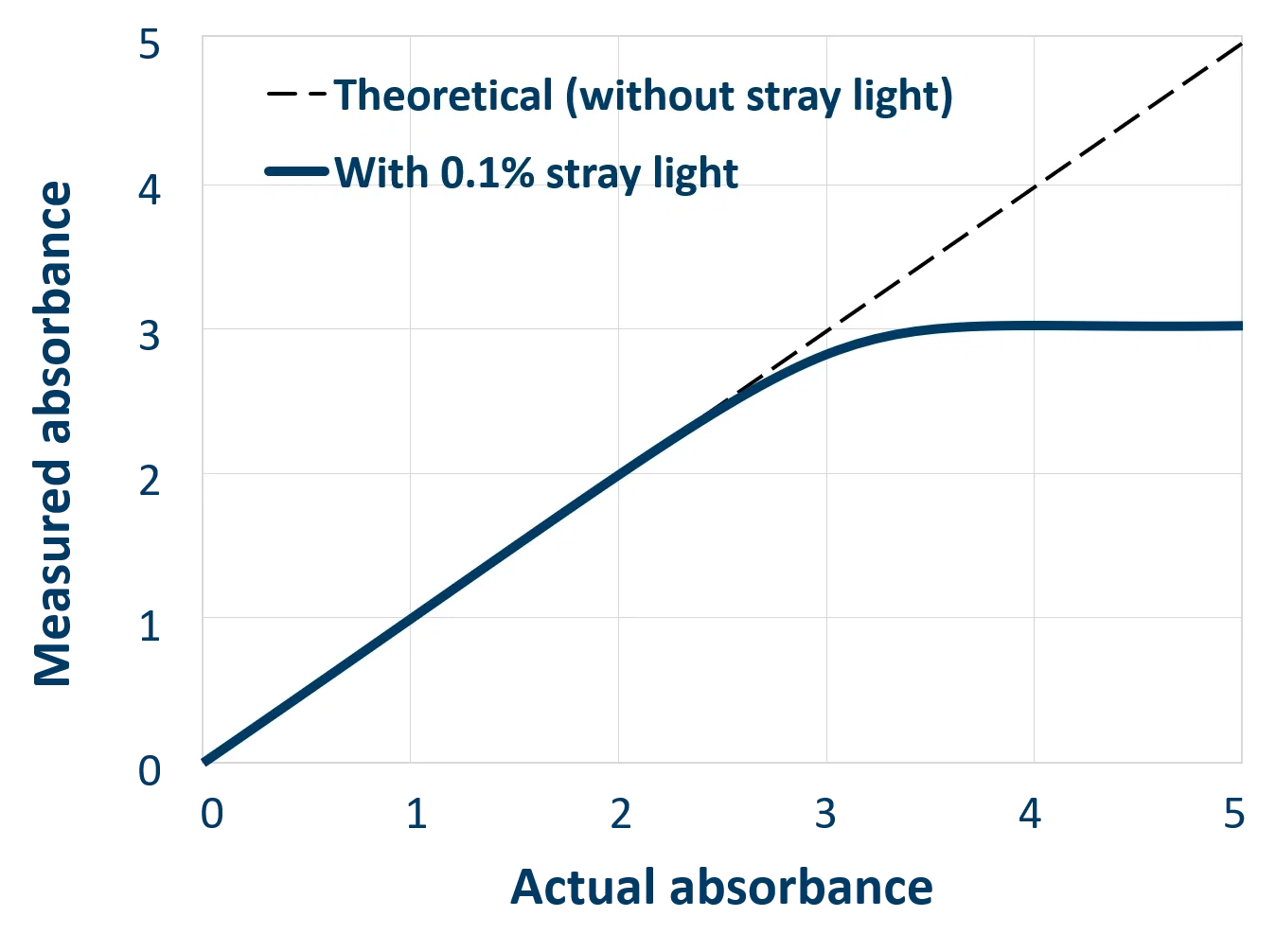
The linear absorbance range in UV-VIS spectrometer instrumentation depends critically on stray‑light suppression. Even small amounts of stray light raise the baseline in high‑absorbance regions and lead to systematic underestimation of concentration. Stray light is unfortunately not defined in a single universal way. Different suppliers, standards bodies, and application areas use different definitions depending on what they consider “out‑of‑band” light and how they choose to quantify it. In UV‑VIS pharmacopoeias, stray light is typically assessed using certified reference materials such as potassium chloride, sodium iodide, acetone, or sodium nitrate, each specified at particular wavelengths where their absorbance is known and traceable.
Absorbance error and SNR
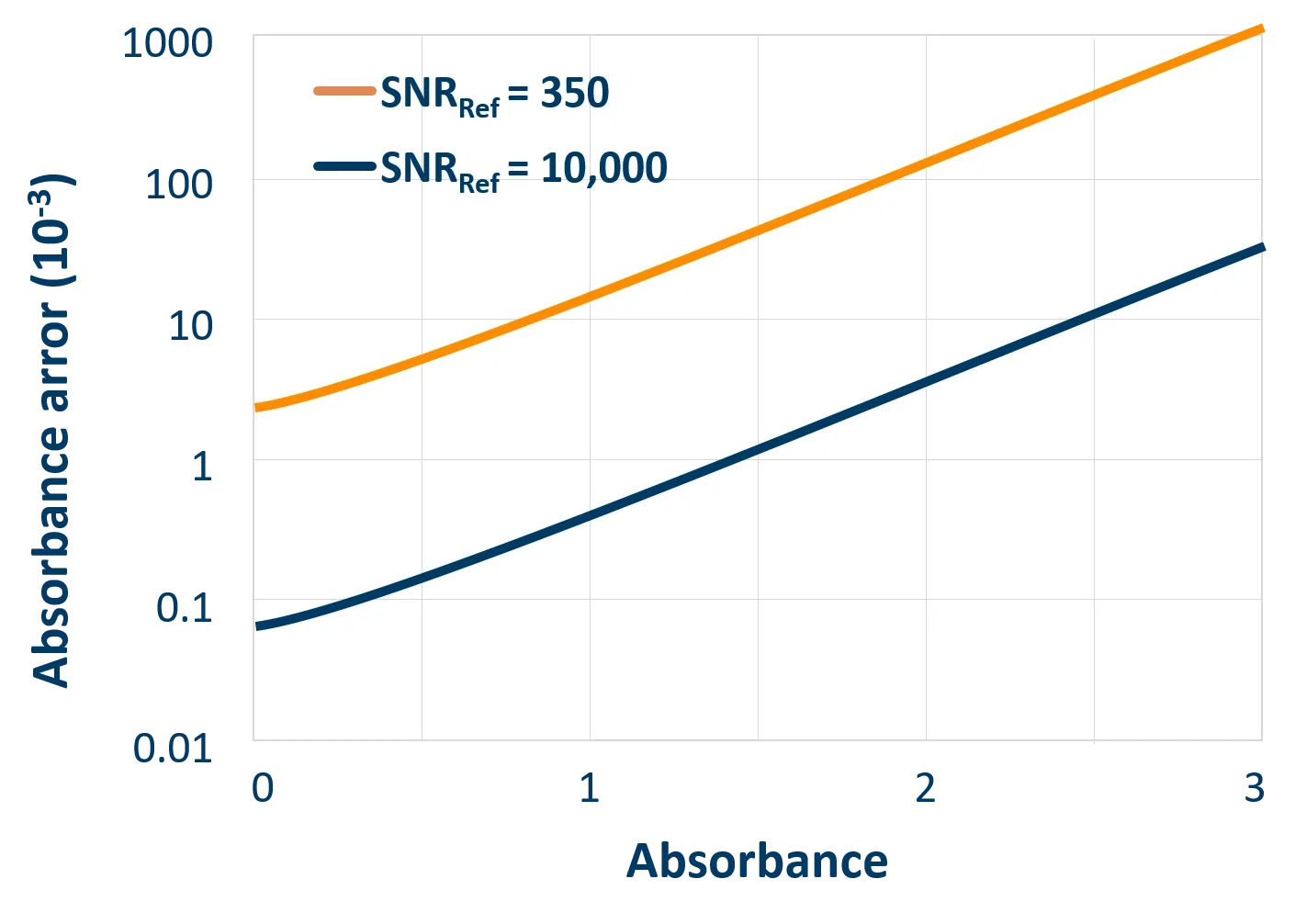
Absorbance error reflects noise in both the sample and reference signals. Because
Absorbance = log10(ISample / IReference)
noise in either channel propagates directly into the final absorbance value. Low absorbance regions are dominated by detector noise, while high absorbance regions are limited by stray light. High throughput optics, stable illumination, and detectors with strong SNR all reduce absorbance uncertainty and improve repeatability.
For low absorbance (close to 0) the absorbance error &sigmaA can be approximated by
σA ≈ 0.61/SNR (absorbance ≈ 0)
However, for larger absorbance values the absorbance error increases as
| σA2 = 0.189 | ( | ( | 1 | ) | 2 | + | ( | 1 | ) | 2 | ) |
| SNRSample | SNRReference |
shown on the figure for 2 different detectors with very different SNRReferece.
Timing performance and synchronization
Applications involving pulsed xenon lamps or transient events such as chromatographic peaks require precise timing. The detector must align its integration window accurately with the illumination pulse or sample event. CMOS detectors with electronic shuttering offer the strongest timing performance, while technologies with longer practical integration times – such as NMOS – are less suited for fast or highly synchronized measurements.
Dynamic range
Dynamic range defines the ratio between the maximum measurable signal and the noise floor in your UV-VIS instrument. It determines how well the instrument can quantify both low absorbance and high absorbance regions without saturation or excessive noise. Deep well detectors such as NMOS provide very high dynamic range but require strong signal levels to exploit it, whereas CMOS offers a balanced combination of dynamic range, speed, and timing flexibility.
Baseline stability
Baseline stability reflects the combined effects of lamp drift, detector noise, temperature variations, and mechanical alignment. Instruments with high throughput and short integration times can acquire reference measurements more frequently, reducing drift induced errors. Stable mechanics, low scatter optics, and well controlled electronics all contribute to maintaining a flat, repeatable baseline over time.
Light source considerations
The light source defines the illumination used to probe the sample and therefore has a major influence on the performance, stability, and measurement accuracy of any UV-VIS spectrometer instrumentation. Different technologies offer different spectral characteristics, noise behavior, and timing requirements, and these factors must be matched carefully to the spectrometer and detector electronics.
Deuterium lamps
Deuterium lamps remain the standard choice for deep UV and broadband UV-VIS instruments. They provide a smooth and stable UV continuum, although they require a warm up period before the output becomes stable. Over time, lamp intensity drifts, which affects baseline stability and increases the need for periodic reference measurements. In full‑range UV‑VIS spectrophotometers, deuterium lamps are often paired with tungsten‑halogen lamps to extend coverage into the visible and NIR.
Xenon flash lamps
Xenon flash lamps deliver high UV intensity in short pulses, making them attractive for compact or low power instruments. Their pulsed nature introduces timing challenges, since the spectrometer must synchronize its integration window precisely with the lamp pulse. This requires accurate trigger signals and low jitter electronics. Pulse to pulse variation can be managed through averaging or reference correction. When properly synchronized, xenon flash systems can achieve excellent UV performance with minimal heat load.
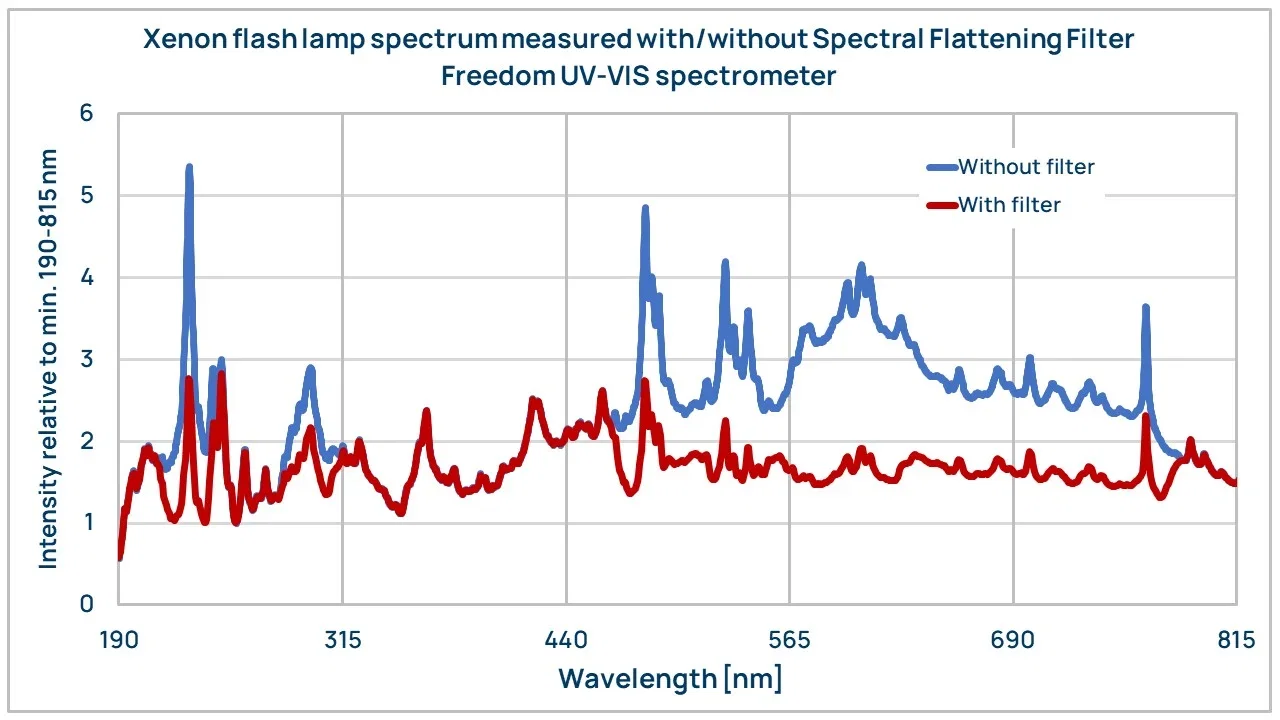
Xenon lamps also exhibit sharp spectral peaks, particularly in the ultraviolet. These peaks can distort absorbance measurements if not corrected. Spectral flattening filters smooth the lamp’s output and improve the uniformity of illumination across the wavelength range, leading to more stable baselines, better SNR, and more accurate absorbance calculations. Ibsen offers spectral flattening filters designed specifically to correct xenon lamp peaks and improve UV VIS measurement uniformity.
LED based illumination for UV-VIS spectrometer instrumentation
LEDs can be used in compact or application specific UV VIS instruments, particularly in the UV A and visible ranges. They offer long lifetime, low power consumption, and fast modulation. Their narrow spectral output and limited deep UV performance, however, make them unsuitable for high precision broadband UV-VIS spectroscopy.
Managing light source drift
All light sources drift over time due to aging, temperature changes, or power supply fluctuations. Drift directly affects absorbance accuracy because absorbance is calculated from the ratio of sample to reference intensity. As the source output changes, reference measurements must be taken more frequently to maintain baseline stability. Instruments with high throughput and short integration times can compensate more easily, since they allow rapid reference sampling without slowing down the measurement cycle. Ibsen’s high throughput spectrometers support this approach, and the trigger enabled electronics in DISB electronics provide precise synchronization with pulsed sources.
Sampling interface and light path
The sampling interface guides light from the source through the sample and into the spectrometer, and its design has a direct impact on throughput, baseline stability, and measurement repeatability. Material choice is especially critical in the ultraviolet, where many common optical glasses absorb strongly and introduce wavelength‑dependent dispersion that distorts the spectral response. For this reason, UV‑VIS instruments typically rely on fused silica optics, which maintain high transmission deep into the UV, or aluminium‑coated mirrors, which avoid chromatic dispersion altogether and provide broad spectral coverage.
Beyond material selection, the geometry of the light path must be matched carefully to the amount of optical power the spectrometer can accept. This is governed by étendue, which describes how the combination of source size and numerical aperture determines the total light that can be transferred through the system. If the illumination source produces a beam with a larger étendue than the spectrometer can accommodate, excess light is lost at the entrance slit. If the source underfills the spectrometer’s acceptance cone, the system operates below its potential signal level. Matching the étendue of the source and the spectrometer ensures efficient coupling, maximizes SNR, and improves the stability of absorbance measurements across the full wavelength range.
Equally important is the control of optical path length through the sample, since absorbance is calculated according to the Beer–Lambert law. Any variation in path length directly affects the measured absorbance and can introduce systematic errors, especially in flow cells or fibre‑coupled sampling geometries where alignment or manufacturing tolerances may vary. Stable, well‑defined path lengths ensure that changes in absorbance reflect only changes in sample concentration, not fluctuations in the optical geometry. This becomes particularly critical in low‑absorbance measurements, where even small deviations can dominate the error budget.
Spectrometer considerations
The spectrometer defines the analytical performance of a UV‑VIS instrument. Its optical design determines resolution, throughput, stray‑light behaviour, wavelength accuracy, and ultimately the quality of the absorbance data. Several tightly connected design choices must be balanced to achieve the required performance.
Grating choice
The diffraction grating determines both the wavelength separation (dispersion) and the efficiency profile of the spectrometer. Blazed reflective gratings have traditionally been the standard choice for UV‑VIS instruments, largely because they have been widely available and well understood for decades. Their efficiency peaks around the blaze angle, and their relatively low dispersion often requires larger optical layouts to achieve high resolution. They are typically produced as replicated gratings, where a polymer layer is cast from a master and coated with aluminium. While cost‑effective, the replication process introduces surface imperfections and micro‑roughness that contribute to stray light.
Ibsen’s fused‑silica transmission gratings offer a modern alternative with several distinct advantages. Because they are true master gratings, fabricated directly in fused silica using semiconductor lithography, they exhibit exceptionally smooth groove profiles and very low scatter. This manufacturing approach is the primary reason for their inherently low stray light. Combined with their flat UV‑VIS efficiency and high dispersion, transmission gratings enable compact spectrometer designs with strong UV performance and excellent baseline stability.
| Grating type | Key characteristics | Impact on instrument |
|---|---|---|
| Blazed reflection | Efficiency peaks at the blaze angle; efficiency drops toward the UV; lower dispersion | Requires larger optical path to achieve high resolution; more sensitive to stray light from surface scatter |
| Fused silica transmission | Flat, broadband efficiency; strong UV performance; inherently low stray light; high dispersion | Enables compact spectrometer designs; supports high resolution in small footprints; excellent UV throughput |
Slit width and spectral resolution
The spectrometer is an imaging system that creates and image of the entrance slit defines onto the detector and therefore the slit width defines the achievable spectral resolution. A narrower slit improves resolution but reduces throughput, while a wider slit increases signal at the expense of spectral detail.
Pharmacopeia guidelines provide a useful rule of thumb: the spectral bandwidth (or spectral resolution) of the instrument should be no more than 10% of the width of the narrowest absorption peak that must be resolved. In practical terms, a peak that is 20 nm wide requires an instrument with a 2 nm spectral bandwidth to ensure proper separation and quantification. The required spectral bandwidth then determines the appropriate slit width, which typically falls in the range of 20–50 µm for a 1–2 nm bandwidth, depending on the grating dispersion and the optical magnification of the spectrometer.
Selecting the correct slit width is therefore a balance between regulatory compliance, sensitivity, and the dynamic range needed for the intended application.
Numerical aperture and throughput
Together with the slit opening area, the numerical aperture (NA) of the spectrometer optics determines how much light can be collected from the sampling interface. High NA designs increase throughput and improve SNR, but they also demand careful control of aberrations and uniformity across the optical path.
Stray light and absorbance linearity
Stray light refers to any light that reaches the detector at a wavelength different from the one the spectrometer is supposed to measure – typically caused by scattering, reflections, or imperfections in optics. Even small amounts of this out‑of‑band light can distort absorbance measurements, especially in high‑absorbance regions where the true signal is very low.
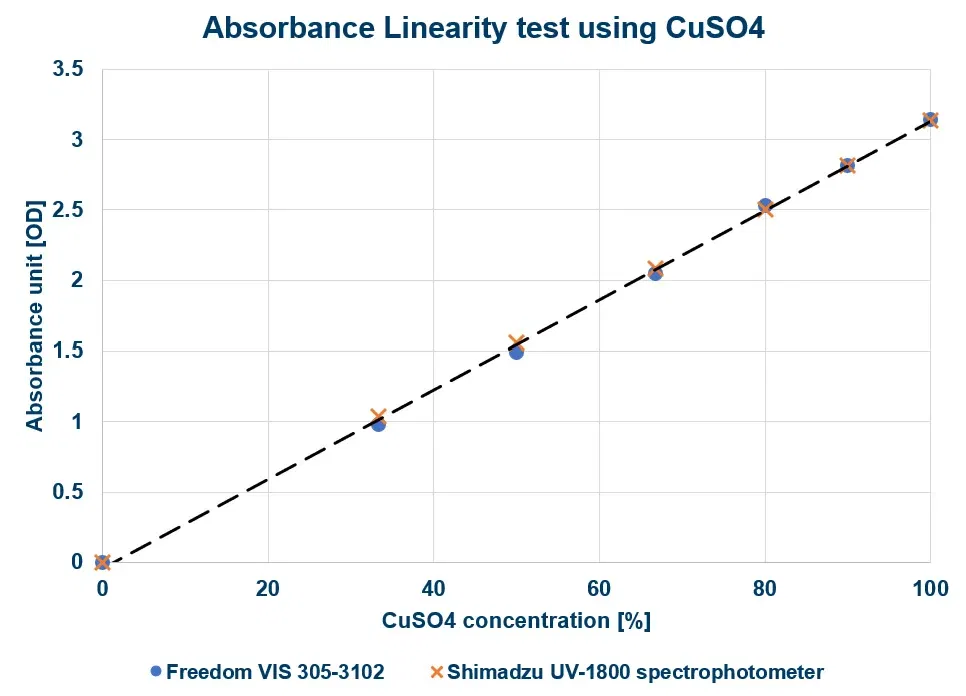
Because Ibsen’s spectrometers use fused‑silica master gratings, combined with optical designs that suppress internal reflections and scatter, they can achieve stray‑light levels below 10⁻³ relative to the reference signal signal. This low stray‑light performance is a key contributor to maintaining linear absorbance behaviour up to high optical densities and ensuring accurate quantification even in the deep UV.
Detector
The detector converts the dispersed light into electrical signals, and its behavior strongly influences SNR, timing, and overall measurement accuracy. The table below compares typical values for the three most commonly used detector technologies for UV-VIS spectrometer instruments.
Ibsen Photonics offers a selection of commonly used detectors for our spectrometers, allowing you to choose the type that best matches your specific needs.
| Technology | Minimum integration time | Typical SNR (single measurement) | Dynamic range (single measurement) | UV-VIS implications |
|---|---|---|---|---|
| BT-CCD (Back illuminated) | 2.5-5 ms | 600:1 | 9,000:1 | Best for low light UV, not suited for timing critical applications |
| Shallow well CMOS | 0.005 ms | 350:1 | 5,000:1 | Best for timing critical applications |
| Deep well CMOS/NMOS | 0.1 ms | 10,000:1 | 20,000:1 | Best for low absorbance error; require strong signal levels, less suited for fast measurements |
Electronics
The detector in a spectrometer outputs an analog video signal that must be amplified and converted into a digital format before it can be processed by the UV‑VIS instrument’s microprocessor. These tasks are handled by the spectrometer electronics, which also control the start and end of the integration periods. When measurements need to be synchronized with an external element—such as a xenon flash lamp—it is crucial that both the detector and the spectrometer electronics support accurate trigger functions.
Ibsen provides dedicated low‑noise DISB electronics tailored to each detector type, ensuring fast, stable, and highly accurate timing control. This electronics platform not only minimizes readout noise but also delivers precise synchronization for demanding UV‑VIS spectrometer instrumentation where timing accuracy is essential.
Other considerations in UV-VIS instrument design
Beyond the main optical and electronic subsystems, several additional factors influence the long‑term performance of a UV‑VIS instrument. Wavelength accuracy depends on the stability of the spectrometer and light source, both of which can shift over time due to temperature changes and mechanical shocks/vibrations.
Software and signal‑processing steps such as dark and reference correction, baseline handling, smoothing, and stray‑light compensation also shape the final spectrum and help maintain consistent analytical performance.
Ibsen’s spectrometers are designed to minimize sensitivity to external factors. The fused‑silica transmission gratings and robust optical layouts with no moving parts provide strong resistance to temperature variations, mechanical vibrations, and long‑term drift, supporting stable wavelength alignment and baseline behavior.
Even with this inherent robustness, regulatory requirements and natural light‑source drift generally mean that periodic calibration of both wavelength accuracy and absorbance accuracy remains essential for ensuring compliance and maintaining reliable measurement performance over time.
More resources
Want to know more?
For further information see below.