
Make or buy your spectrometer
Selecting a spectrometer for an analytical instrument requires a strategic sourcing decision, balancing standard versus customized solutions and in‑house versus outsourced design and manufacturing. This white paper compares common approaches and explains why partnering with a supplier that combines deep OEM design expertise with proven manufacturing capabilities often delivers the strongest results.
Why the Make-or-Buy decision matters for OEM spectrometers
The analytical instrumentation market is broad and diverse, serving industries from pharmaceuticals and life sciences to food safety and materials analysis. Instruments rely on specialized submodules such as spectrometers, which perform essential measurement functions. Unlike consumer electronics, they are produced in relatively small volumes, often between 100 and 1,000 units each year, and must meet strict standards for precision, reliability, and regulatory compliance.
Design lifecycles usually span 10 to 15 years, with developers reluctant to introduce new hardware because of the cost and effort required for regulatory approvals and validation as well as limited resources and competing priorities. Once integrated into workflows, instruments are expected to remain stable, discouraging frequent hardware updates that could disrupt compliance or data continuity. Physical designs often remain unchanged for decades, while improvements are delivered mainly through software updates.
Spectrometers are among the most demanding submodules, requiring expertise in optical-, mechanical-, and electronic engineering. Optical design optimizes components such as gratings and mirrors, mechanical design ensures alignment and stability, and electronics manage detector integration and signal processing.
These challenges drive strategic decisions about whether to design and manufacture components internally or source them externally. The spectrometer, because of its complexity and impact on overall performance, often becomes central to this debate.
This white paper frames the discussion around three questions:
- Should we use an off the shelf spectrometer or develop a custom solution?
If custom:
- Should the design be completed internally or outsourced?
- Should manufacturing be handled inside the company or contracted out?
Rather than prescribing a single approach, we offer guiding principles to help developers make context specific decisions when integrating spectrometer submodules into advanced analytical instruments.
Download the full white paper:
Inside spectroscopy instruments
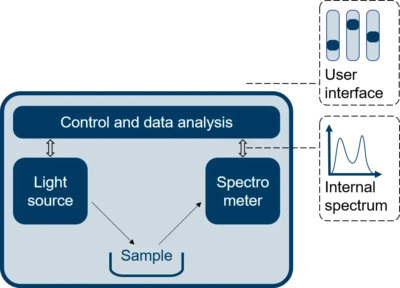
To set the stage, it is important to first understand how instruments for spectral analysis are typically structured. These systems are composed of several high-level modules, each playing a distinct role in the measurement process.
Overall, instrument manufacturers must master sample handling and data processing, while the light source and spectrometer can be acquired from external suppliers.
Off-the-Shelf or customized spectrometer?
Once the spectrometer requirements have been defined, the first decision is whether an off-the-shelf spectrometer can meet the application’s needs. While standard products may offer a shorter path to market, they are not always optimized for OEM integration, long-term consistency, or cost-performance balance. Customized spectrometers can be tailored to the right balance between the specific requirements and cost of the instrument.
Who should design the spectrometer?
Designing a spectrometer requires expertise across optics, mechanics, electronics, and software. Manufacturers must therefore decide whether development should be carried out internally, outsourced to an engineering partner, or entrusted to a specialized spectrometer supplier. The best approach depends on factors such as the strategic importance of the spectrometer, access to relevant expertise, development risk, and long-term product support requirements.
Who should manufacture the spectrometer?
Spectrometer manufacturing involves precision assembly, optical alignment, and stringent quality control. Companies may choose to manufacture spectrometers in-house, outsource production to a contract manufacturer, or partner with a dedicated spectrometer supplier. Each approach offers different trade-offs in terms of investment, scalability, quality assurance, and operational complexity. The right choice will depend on existing capabilities, production volumes, and long-term business objectives.