
What is spectral beam combining?
Modern laser sources can deliver multiple kilowatts of power, but directed energy applications demand power levels up to 300 kilowatts. Spectral beam combining (SBC) is an optical technique that spatially merges multiple laser beams of different wavelengths into a single, high-power output beam while preserving beam quality.
Unlike coherent beam combining (CBC), which relies on phase-locking, SBC leverages the wavelength-dependent diffraction of optical gratings to spatially overlap beams, enabling reliable power scaling without the complexity of active phase control.
How spectral beam combining works
Laser sources
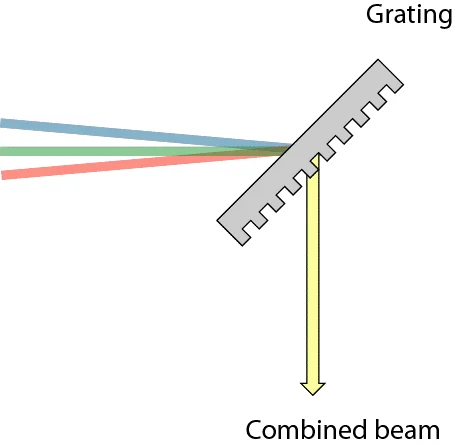
Multiple laser sources (e.g., diode lasers, fiber lasers) can be engineered to emit at slightly different wavelengths (e.g., 1040 nm, 1042 nm, 1044 nm etc).
Diffraction grating
A high-efficiency grating diffracts each wavelength determined by the grating equation:
λ=Λ(sinθi+sinθd), where:
λ = wavelength
Λ = grating period
θi = incident angle
θd = diffracted angle.
Spatial overlap
By directing the laser beams, with each wavelength at its appropriate angle of incidence, onto the grating, the diffracted outputs overlap spatially, creating a single, high-brightness beam with minimal loss.
Key advantages over alternative methods
Simple
Spectral beam combining is completely passive, unlike coherent beam combining, which requires continuous feedback sensing and complex phase locking of the independent laser sources .
Scalable
The diffraction grating covers a wide wavelength band – simply add more wavelengths to increase power.
Reliable
Fused silica transmission gratings can handle more than 3 MW/cm2 power density.
Fused silica transmission gratings for spectral beam combining
More resources
Which transmission grating to use?
For further information or to request a quotation please contact us.